

Have Dynamic Drivers Really Improved—or Just the Manufacturing?
Last updated: September 2026 · Reading time: 4 minutes · By: XCHIFI Engineering Team · Category: IEM Drivers & Technology
Short answer: no, the dynamic driver has not fundamentally advanced in decades. The 1925 Rice-Kellogg moving-coil principle is still the only mechanism in every dynamic driver shipping today. What HAS improved is the factory: process control, yield rate, and unit-to-unit consistency. Those are real engineering gains, but they’re not sound-quality gains. And a brand-new driver is not automatically better than its predecessor — sometimes it’s worse.
If you already enjoy the IEM you have, a new model name is not a reason to replace it.
The principle hasn’t moved in 100 years
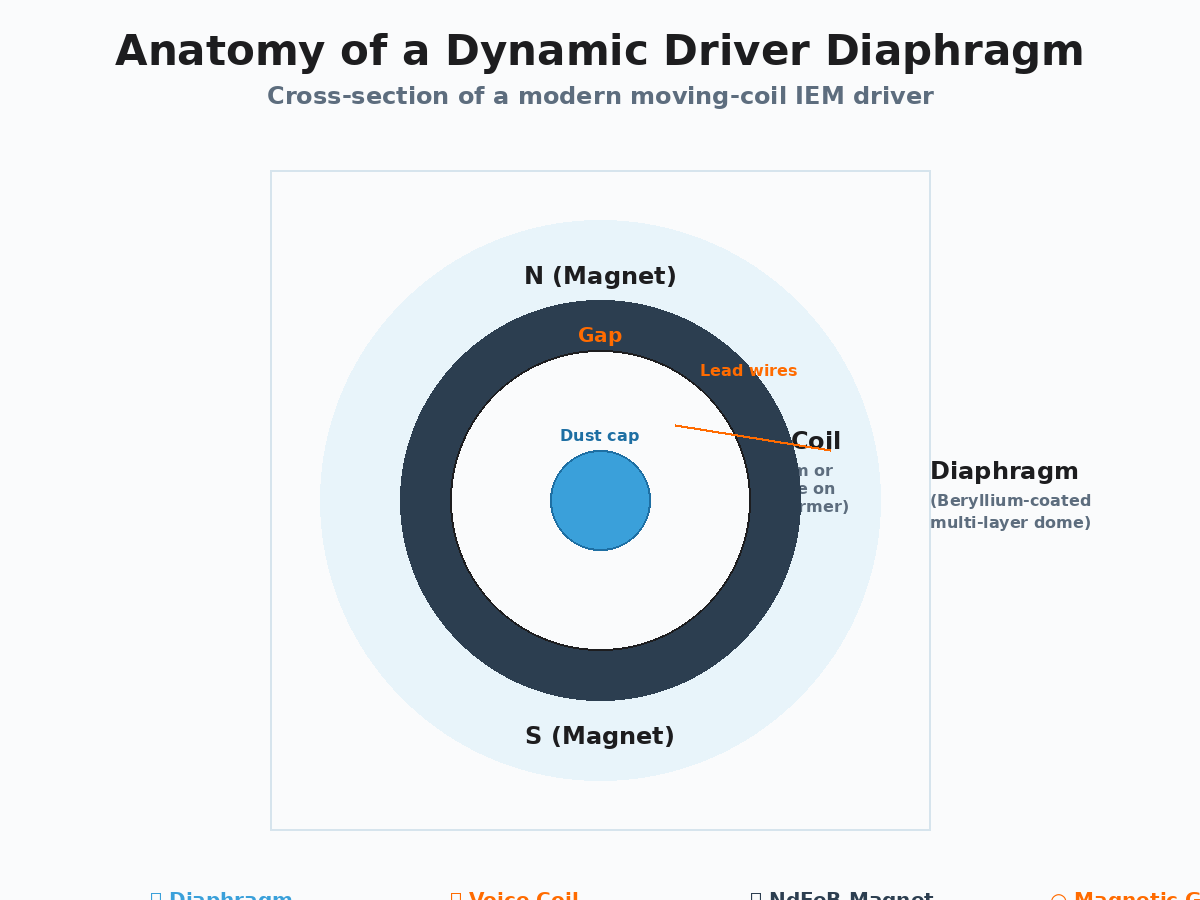
An electrical signal drives a coil in a magnetic field. The coil moves a diaphragm. The diaphragm moves air. That’s it. Every “innovation” you see in product copy — DLC dome, LCP composite, beryllium coating, multi-layer sandwich — happens inside this fixed 100-year-old framework. None of them replace the mechanism. They tweak one variable in a system where at least seven others (magnet, coil, suspension, vents, nozzle, ear-tip seal, chamber geometry) decide how it actually sounds.
What actually improved: the factory, not the driver
Three things, and only three, deserve credit for real change in dynamic drivers over the last two decades.
Process control. Coil centering, adhesive placement, diaphragm forming — automated lines now hold tolerances hand-assembly in the 1980s couldn’t.
Yield rate. More units pass the acceptance test. A modern budget line ships 85–95% of units, up from 50–70% on the same line twenty years ago.
Unit-to-unit consistency. Channel matching and run-to-run variation are tighter. Two IEMs from the same production run today sound closer to each other than two IEMs from a 2005 run.
Those are real gains. They are not sound-quality gains. A line that hits its target curve more consistently doesn’t sound better per unit — it sounds the same, just more predictably. Yield measures how many units pass QC; it doesn’t measure how good those units sound.
A new driver can be worse than its predecessor
This is the part marketing copy never writes. Three real reasons a refresh can be a regression.
BOM pressure. Every refresh, procurement renegotiates with suppliers. A slightly cheaper magnet (one grade lower of NdFeB) or thinner CCAW wire can land in the “new improved” version as long as it still passes QC. The spec sheet still says “NdFeB magnet.” It just doesn’t say which grade.
Tuning drift toward Harman. Since around 2019, the Harman 2019 target has dominated the market. New models chase the curve. If your older unit was tuned closer to neutral and you liked that, the “improved” successor with stronger bass and rolled-off treble will sound worse to you — even if it measures better against the new industry target.
Driver simplification. Some “second-generation” drivers go from sandwich construction to a single layer. Marketing calls it “purified single-layer LCP.” The actual acoustic result is worse damping — usually audible as more ringing in the 5–8 kHz range.
So don’t chase new
Upgrade only when one of these is true: lower measured distortion, better channel matching, tuning that actually fits your preference where your current IEM doesn’t, more clean output before compression, or documented reliability gains.
If your reason is “it has the new diaphragm material” — that’s not a reason. “New” is a release date. “Better” needs an explanation you can verify with measurements or your own ears.
Keep what you like. Buy what you’ve measured and heard, not what the press release promises.
FAQ
Have dynamic drivers actually improved?
Not fundamentally. The mechanism is unchanged since 1925. Manufacturing has improved — tighter tolerances, higher yield, more consistency — but those are factory gains, not sound-quality gains per unit.
Can an older IEM sound better than a new one?
Yes. A well-built 2018-vintage IEM isn’t “outdated” — the diaphragm it shipped with is still working to the same physics. Older units from reputable brands often hold their tuning and build quality long after newer models land.
Should I upgrade to the latest release?
Not on release date alone. Refreshes can be neutral, slightly better, or slightly worse. Wait for measurements and listening impressions from owners with similar gear and music. If nothing measurable changes for you, keep what you have.
This is XCHIFI’s engineering view: prioritize measurable acoustic fundamentals over material marketing. Specifications reflect industry-standard ranges; individual products vary. Always verify with independent measurements and your own listening tests.