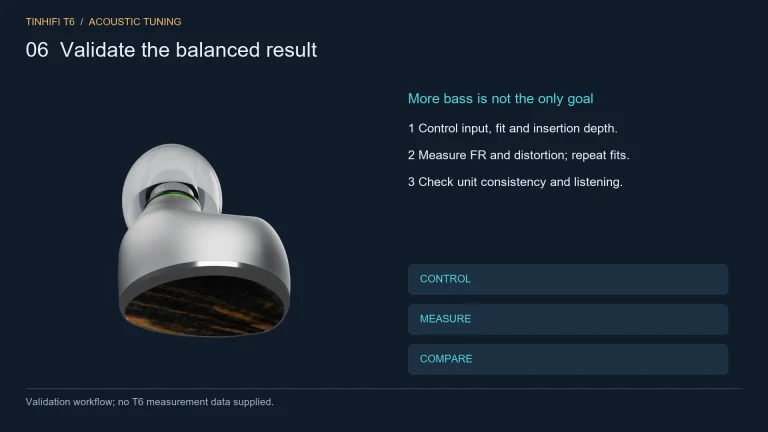
How to Build an IEM with Powerful Bass: TINHIFI T6 Explained
How do you build an IEM with powerful bass? Explore TINHIFI T6 tuning through seal, APC damping, vents and chambers while preserving balance.

IEM GUIDES / ENGINEERING & LISTENING
Good IEM development starts with a listening goal and a repeatable way to measure it. Driver count is only one design decision. The driver response, electrical network, acoustic load and fit all contribute to the result.
Understand how each driver contributes across frequency and how amplitude and phase combine. A layout label alone cannot establish coherence or sound quality.
Identify the ear simulator, insertion method, ear tips and normalization before comparing graphs. Keep calculated examples separate from measured product performance.
A useful brief defines fit, target response, source compatibility and acceptable unit variation. Validation should address repeated insertions and more than one sample.
Technical reference: COMSOL: modelling speaker drivers
How do you build an IEM with powerful bass? Explore TINHIFI T6 tuning through seal, APC damping, vents and chambers while preserving balance.
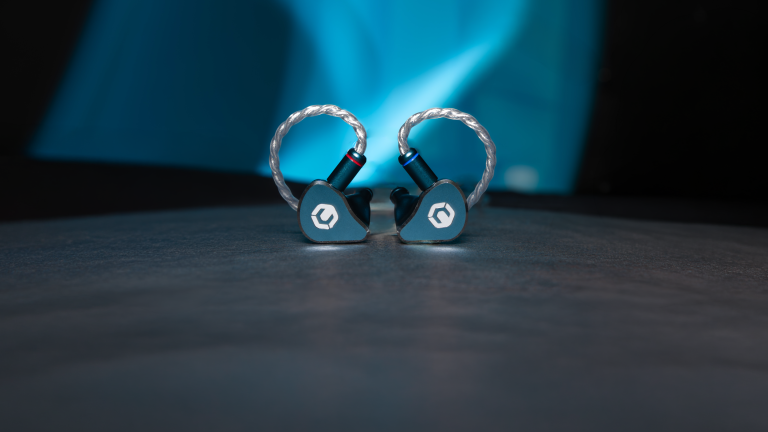
Is the Harman target overrated? Examine CrinEar tuning, IEF Preference 2025, measurement limits and practical ways to stop chasing IEM upgrades.
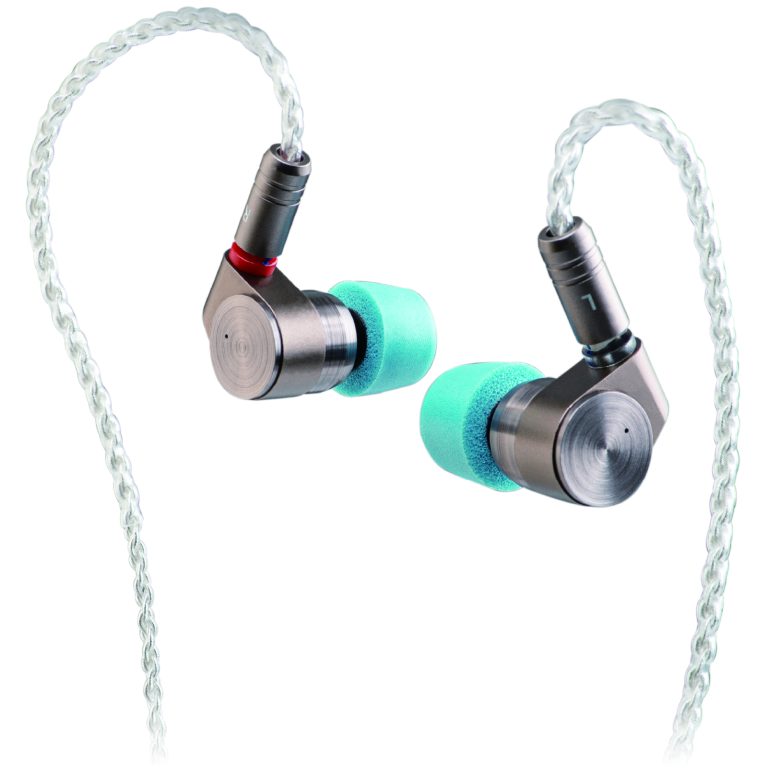
Compare classic TINHIFI T2 and CrinEar Nightfall: driver roles, bass tuning, acoustic chambers, phase, source matching and USB-C EQ.
Developing an earphone? Explore OEM / ODM or share your project brief.