
CHU 2 vs CHU 3 is also a question of materials, fit and finish. Both models have zinc-alloy housings, according to their published product information. That shared material helps explain how affordable earphones can offer complex metal shells, but it does not prove identical comfort or paint durability.
This guide is for buyers comparing CHU II vs CHU III and creators planning their own earphone project. It examines housing manufacture, coating wear and indicative production costs. It is a sourced materials guide, not a hands-on sound comparison or a controlled durability test.
CHU 2 vs CHU 3: What Do We Know About the Shells?
| Housing question | CHU 2 / CHU II | CHU 3 / CHU III |
|---|---|---|
| Published shell material | Zinc alloy | Zinc alloy |
| Evidence used here | Manufacturer product page | Published retailer specifications |
| Finish concerns | Individual owners report coating wear or peeling | Online reports discuss chipped paint; the cause of some pictured damage is disputed |
| Comfort verdict | Depends on ear shape, tips and contact points | Requires the same individual fit assessment |
The CHU II manufacturer page identifies a zinc-alloy cavity and a separate brass nozzle. CHU III product specifications also list a zinc-alloy cavity. The aluminum-magnesium material mentioned in driver specifications refers to the diaphragm, not the housing.
A CHU III paint discussion, including owner photographs contains reports about both generations. Some participants attribute pictured damage to impact; others report early chipping. These are individual accounts, not verified defect rates or proof of a common manufacturing fault. They cannot establish that CHU 3 is universally better or worse than CHU 2.
How Are Zinc-Alloy IEM Shells Made?
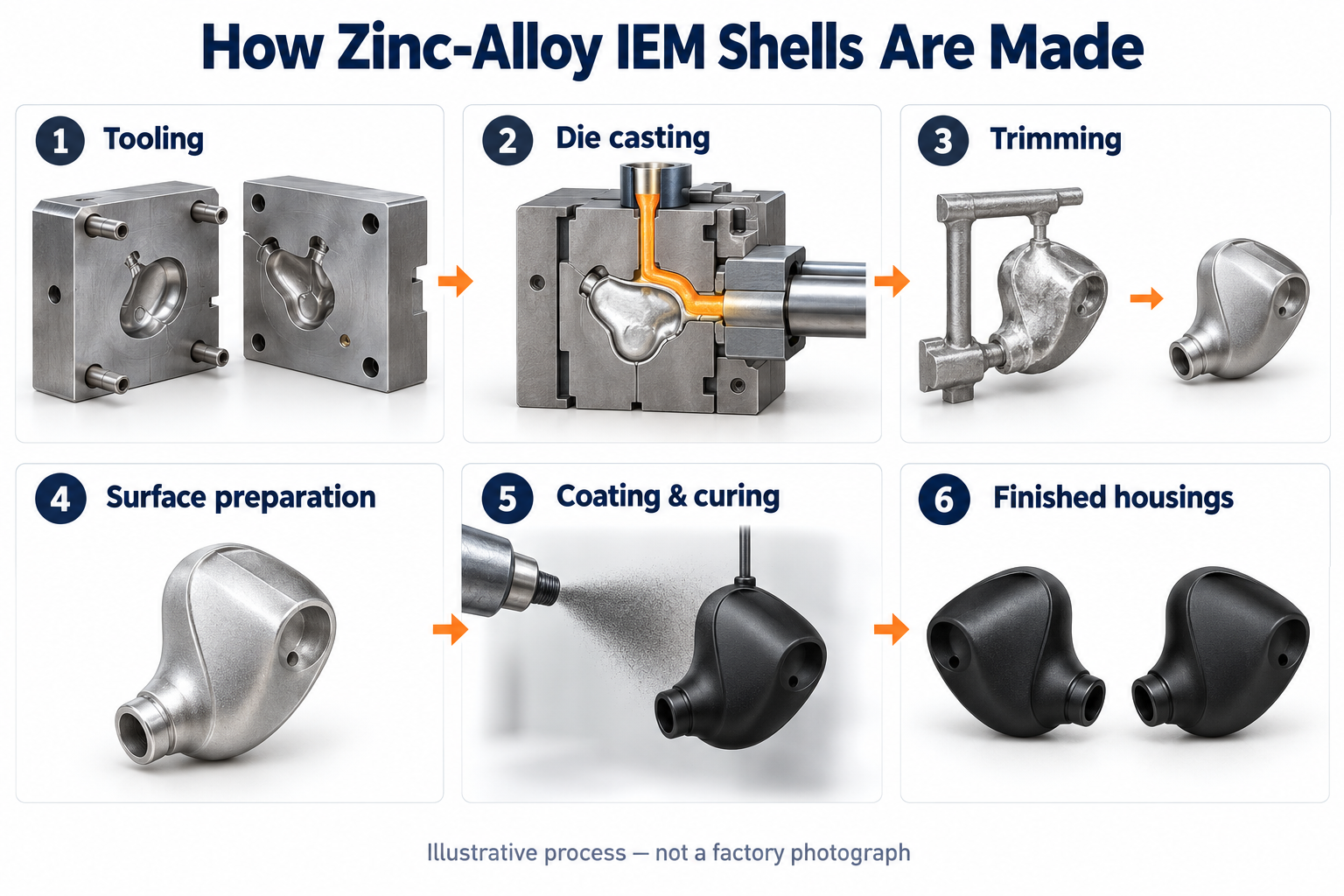
A typical die-casting route starts with a custom steel tool. Molten zinc alloy fills the tool under pressure, cools into the required shape and is ejected. The process can reproduce small, complex features efficiently. The sequence below explains a common manufacturing route; it is not a verified record of either model’s factory process.
The cover image is an AI-generated illustration of the typical manufacturing sequence, not a CHU 2 or CHU 3 factory photograph.
- Design and tooling: define the shell geometry, cavities, parting surfaces and features needed for assembly.
- Casting: melt the selected zinc alloy and form the parts in the metal mold.
- Trimming and deburring: remove runners, excess material and sharp edges.
- Local machining: finish critical interfaces where the design requires tighter control.
- Surface preparation: clean the casting and prepare it for the chosen coating system.
- Finishing and inspection: apply and cure the coating, then inspect the empty housing before assembly.
The attraction is repeatability at scale. Complex shells can be formed with less extensive cutting than a design machined entirely from solid metal. Zinc casting also supports efficient cycles and durable tooling. These are general manufacturing advantages, not a guarantee that every design is inexpensive. Zinc die-casting process reference.
Zinc-Alloy Housing Cost: RMB 20,000–30,000 for Tooling?
For early project planning, XCHIFI’s indicative reference budget is RMB 20,000–30,000 for custom housing tooling and approximately US$3 for a finished left-and-right housing pair.
| Item | Reference budget | What it means |
|---|---|---|
| Custom housing tooling | RMB 20,000–30,000 | Separate upfront investment; scope depends on the design |
| Finished housing pair | Approximately US$3 | Left and right housings, not a complete earphone set |
These figures are project-planning estimates supplied by XCHIFI, not fixed quotations or verified CHU 2 or CHU 3 production costs. Order quantity, geometry, tooling layout, finishing requirements and inspection standards affect the final price. Coating and finishing scope should be confirmed in the quotation.
Drivers, cables, acoustic components, final assembly, packaging and other project expenses require separate budgeting. A low housing price does not remove development costs: larger runs spread the tooling investment across more pairs, while a small run may make another production method more economical.
Are Zinc-Alloy Earphones Too Heavy?
Zinc alloy has a relatively high density, so weight deserves attention when designing an IEM. However, material alone does not determine the finished earpiece weight. Wall thickness, overall size and internal construction also matter. ASME’s overview of zinc casting discusses this material trade-off.
Pressure is also about where the housing touches your ear. A small contact point, unsuitable tip size or cable tension can make a compact metal shell uncomfortable. Conversely, a well-supported fit can feel comfortable despite the material. CHU II owner reviews include positive comfort experiences, so it would be misleading to describe either generation as painful for everyone.
When choosing between CHU 2 and CHU 3, assess your own fit and the seller’s return terms. This guide has no matched measurements of their earpiece weight and cannot rank one as lighter. For a new product, test working samples over realistic listening sessions before committing to tooling.
Why Paint Zinc-Alloy Shells—and Why Can Paint Peel?
Paint provides color and texture and helps protect the underlying metal. In English manufacturing terminology, this is painting or protective coating; the Chinese workshop term sometimes translated as “spraying oil” does not mean applying lubricating oil.
Good adhesion depends on cleaning, suitable pretreatment, coating selection and curing. The International Zinc Association’s wet-painting guide explains the importance of pretreatment and water resistance, and notes that edges can receive a thinner paint film. Other surface-finishing methods are also possible.
- Impact chipping: a drop or collision can break a local area of coating.
- Abrasion: repeated rubbing can gradually wear contact areas.
- Adhesion failure: problems in surface preparation or the coating system can contribute to lifting or peeling.
- Environmental exposure: moisture and residues can challenge the finish, particularly where protection is already damaged.
These are possible mechanisms, not a diagnosis of any photographed CHU unit. Likewise, discoloration of a separate brass nozzle is not automatically the same problem as paint loss on a zinc-alloy shell.
CHU 2 or CHU 3 Paint Peeling: What Should You Do?
- Document the damage. Take clear photographs and keep your purchase details. Contact the seller if the finish arrived damaged or deteriorated unusually quickly.
- Keep the housing dry. Wipe the exterior gently with a soft, dry cloth after use. Keep liquids away from openings.
- Reduce rubbing. Store the earpieces separately within a suitable case instead of allowing metal parts to knock together.
- Avoid improvised refinishing. Sanding an assembled IEM or applying solvent, nail polish or spray paint can introduce debris, affect openings or damage other components.
- Check function separately. Cosmetic paint loss does not by itself prove driver failure. Loose material, rough edges or changes in sound justify further assessment.
Frequently Asked Questions
Does CHU 3 solve CHU 2 paint peeling?
The sources reviewed here do not establish that. Both have online finish-related reports, but those reports do not provide comparable failure rates or controlled testing.
Does US$3 buy a complete pair of earphones?
No. Our reference figure is for a finished housing pair. It excludes the separate tooling investment and the other components and work required to produce complete earphones.
Is a metal shell always better than a plastic shell?
No single material guarantees the best result. Choose the construction around fit, weight, geometry, finish, production quantity and target cost. A metal exterior alone is not a sound-quality rating.
Planning Your Own Earphone Brand?
The practical lesson from CHU 2 vs CHU 3 is to evaluate the complete design: shell material, fit, finish and after-sales experience. Manufacturing an affordable housing is one part of building a product people will want to buy.
If you have an audience, a sales channel or a clear market idea, share your target price, expected quantity and comfort requirements with XCHIFI. We can discuss housing options and a realistic development budget. Read our ZERO2 vs ZERO3 guide to building an IEM brand, or contact XCHIFI about your project to start shaping your project.