
Sometimes—but it can also make an IEM quieter without giving you the bass you want. A simple impedance adapter adds resistance between the source and earphone. The result depends on the earphone’s electrical impedance across frequency.
Why the sound can change
The added resistance and the IEM share the available voltage. If the IEM presents different impedances at bass, midrange and treble frequencies, each region can be reduced by a different amount. Bass may become stronger relative to the rest, even though the adapter supplies no extra power.
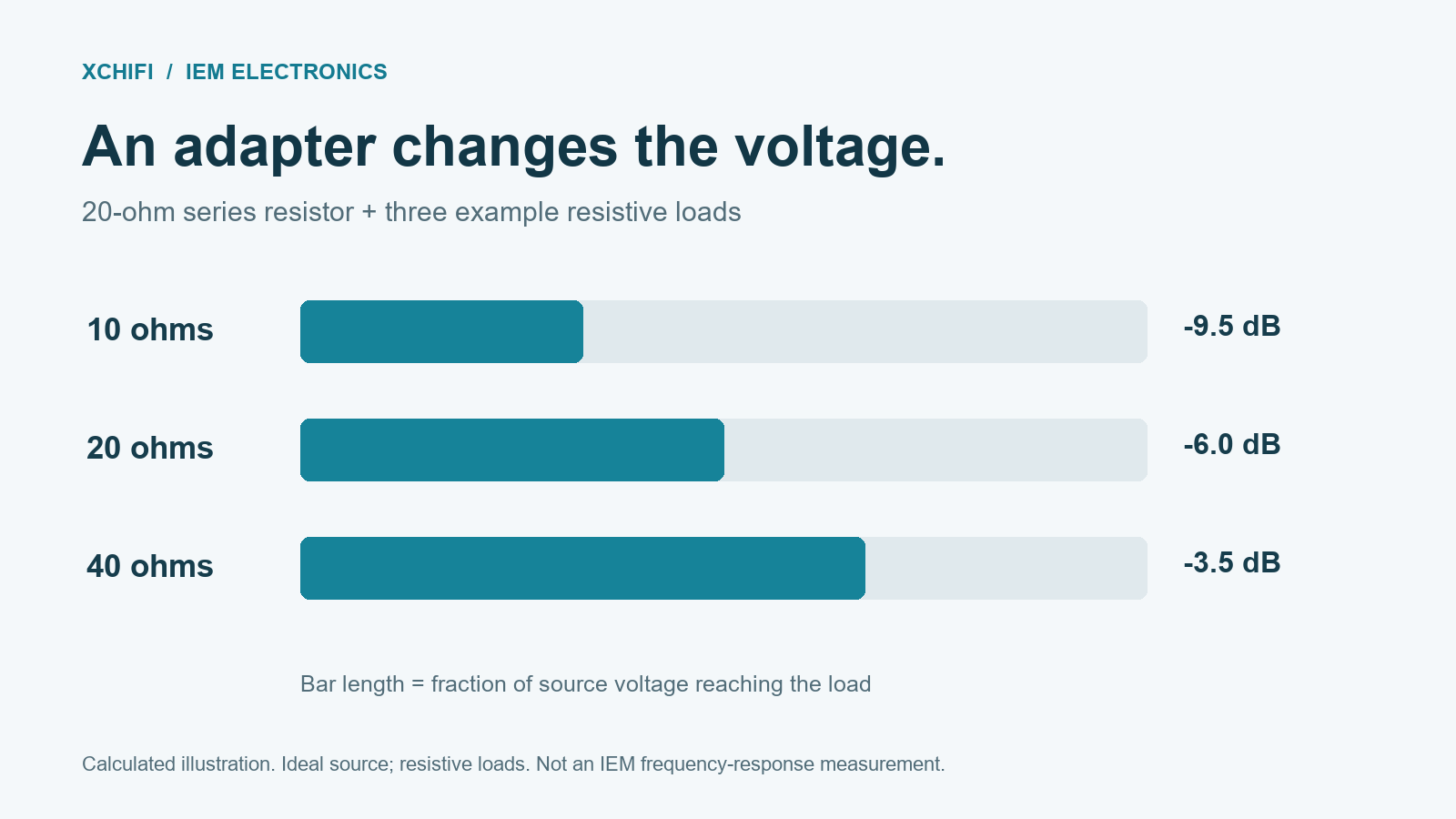
For a simple resistive example, add 20 ohms in series. A 10-ohm load receives one-third of the source voltage; a 20-ohm load receives half; a 40-ohm load receives two-thirds. Those are approximately −9.5, −6.0 and −3.5 dB. These are example loads, not measured bass, midrange or treble values.
Why one person’s result may not match yours
Different drivers and crossover networks present different loads. A fairly flat impedance curve may mostly mean lower volume; a strongly varying curve can produce a larger tonal change. The nominal impedance printed on the box is not the full curve.
Before buying
Check evidence for your exact IEM and adapter value. Compare at matched listening volume, and allow for reduced maximum output. A dedicated attenuator with a more complex circuit may behave differently from a single series resistor.
For a controlled bass change, EQ with enough headroom is often easier to adjust. An adapter is a tuning tool, not a quality upgrade for every earphone.
Further reading: Benchmark on headphone impedance and source matching.