
Before an earphone reaches your ears, engineers check its frequency response, distortion and channel matching. On a production line, those measurements must be repeatable—and fast enough to test thousands of units.
Today, much of that work can be controlled from a computer. In the 1990s, that was a different way of thinking about audio measurement.
From Brüel & Kjær to a New Idea
Before founding Listen, Inc., Steve Temme worked as an acoustic test and measurement applications engineer at Brüel & Kjær (B&K). He had also worked in loudspeaker design. In 1995, a client challenged him to build a computer-based audio test system: if it met the company’s needs within six months, the client would buy it. The project became SoundCheck and led him to establish Listen, Inc. Source: Listen, Inc.
A Computer Becomes Part of the Test Bench
Traditional audio analyzers relied heavily on dedicated hardware. SoundCheck took a different approach: software on a computer controls the test and analyzes results, while connecting to suitable audio interfaces and measurement equipment.
The first system used a commercial data acquisition card; support for professional soundcards followed. This made the setup more flexible, but the computer did not eliminate the need for calibrated microphones, acoustic couplers and other hardware. Source: SoundCheck innovation timeline.
Why a Short Sweep Matters
On an earphone production line you may hear a quick rising tone as each unit is tested. One signal used in SoundCheck is Stweep™, developed by Temme in 1995. It moves through test frequencies with smooth transitions, helping reduce settling time between steps. A short test can help reveal unusual response, distortion or a mechanical buzz. Source: Listen, Inc.
SoundCheck’s Technical Breakthroughs
Temme’s research at B&K carried into his later work. In a 1993 AES paper, he proposed frequency-normalized distortion; Listen says the method has been available in SoundCheck since 1996. It offers another way to interpret distortion measurements alongside conventional methods. Source: Listen, Inc.
SoundCheck also introduced Stweep™, a stepped-sine test signal designed for smooth transitions between frequencies, and a sequence editor for configuring automated test workflows. These tools help engineers balance measurement requirements and production speed; accuracy still depends on the full system and test conditions.
SoundCheck and B&K: Software Meets Measurement Hardware
Temme’s departure did not mean the technologies could not work together. A historical B&K case study describes SoundCheck being marketed by B&K and used for mobile-phone testing. Listen has also documented a headphone test setup combining SoundCheck with a B&K head and torso simulator. B&K case study · Listen setup example.
In such a system, software manages the test and analyzes results, while a suitable ear simulator, microphone and interface capture the signal. Hardware compatibility and calibration should be checked for each setup.
SoundCheck Today: AudioConnect 8×8
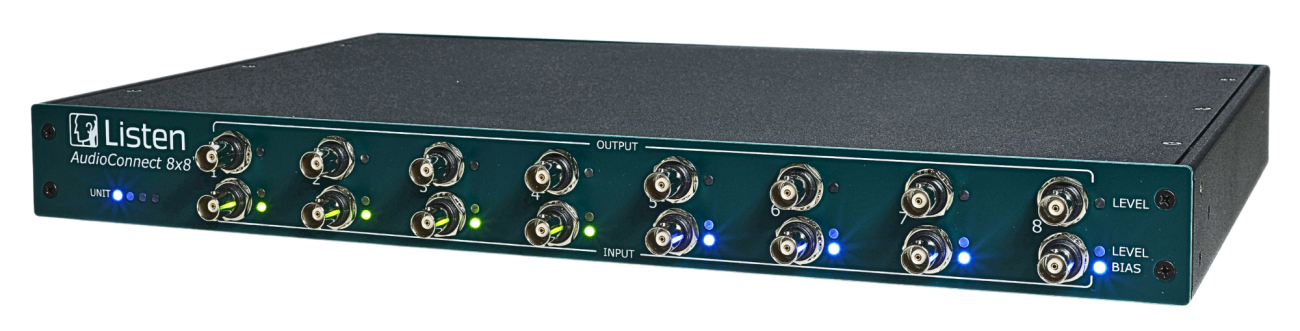
SoundCheck is software; AudioConnect 8×8 is a separate measurement interface made to work with it. According to Listen, it provides eight analog inputs and eight outputs, supports microphones and couplers, and can be expanded with additional units for multichannel testing. SoundCheck controls the interface and helps configure measurement paths. Explore AudioConnect 8×8 at Listen, Inc.
What It Means for IEMs
Measurement is not just about drawing an attractive frequency-response graph. During development, engineers can investigate how changes to a driver, nozzle or acoustic chamber affect the result. During production, measurements help identify units that differ too much from the approved sample.
The coupler, microphone, calibration and way an earphone is positioned all affect the measurement. Useful results depend on the whole setup—and on the person interpreting them.
SoundCheck’s story reminds us that audio progress is not limited to new drivers or materials. Making the tools behind the sound more practical can change how products are developed, too.