
Quality IEM diaphragms last decades under normal use. The most common failure modes are cable damage (replaceable) and housing cracks (from drops). The diaphragm itself rarely wears out.
Does diaphragm material affect sound signature?
Yes, but less than tuning and chamber design. A beryllium driver might extend treble slightly more than aluminum, but the housing acoustics and crossover network usually have 10x more impact on the final sound.
Material property values cited (Young’s modulus, density, loss factor) are based on standard engineering references and manufacturer datasheets. Exact values vary by formulation, manufacturing process, and measurement method. Specifications reflect industry knowledge as of 2026.
No. “Beryllium” in marketing usually means beryllium coating (a few microns thick) on a substrate of aluminum, polymer, or other material. True pure beryllium diaphragms are rare due to brittleness and manufacturing difficulty. The coating thickness and substrate material significantly affect performance.
Will my IEM’s diaphragm wear out?
Quality IEM diaphragms last decades under normal use. The most common failure modes are cable damage (replaceable) and housing cracks (from drops). The diaphragm itself rarely wears out.
Does diaphragm material affect sound signature?
Yes, but less than tuning and chamber design. A beryllium driver might extend treble slightly more than aluminum, but the housing acoustics and crossover network usually have 10x more impact on the final sound.
Material property values cited (Young’s modulus, density, loss factor) are based on standard engineering references and manufacturer datasheets. Exact values vary by formulation, manufacturing process, and measurement method. Specifications reflect industry knowledge as of 2026.
Beryllium is toxic in dust form (berylliosis is a serious lung disease). However, solid beryllium diaphragms are sealed inside the IEM shell and pose no inhalation risk during normal use. Manufacturing beryllium diaphragms requires specialized facilities to protect workers from dust.
Are all “beryllium” IEMs the same?
No. “Beryllium” in marketing usually means beryllium coating (a few microns thick) on a substrate of aluminum, polymer, or other material. True pure beryllium diaphragms are rare due to brittleness and manufacturing difficulty. The coating thickness and substrate material significantly affect performance.
Will my IEM’s diaphragm wear out?
Quality IEM diaphragms last decades under normal use. The most common failure modes are cable damage (replaceable) and housing cracks (from drops). The diaphragm itself rarely wears out.
Does diaphragm material affect sound signature?
Yes, but less than tuning and chamber design. A beryllium driver might extend treble slightly more than aluminum, but the housing acoustics and crossover network usually have 10x more impact on the final sound.
Material property values cited (Young’s modulus, density, loss factor) are based on standard engineering references and manufacturer datasheets. Exact values vary by formulation, manufacturing process, and measurement method. Specifications reflect industry knowledge as of 2026.
7. What to Look for When Buying
Diaphragm material is just one part of the IEM sound. Here’s how to evaluate it:
- Don’t pay premium just for “beryllium” labeling. Many $50 IEMs use the same beryllium coating process as $500 IEMs — what changes is the acoustic chamber, tuning, and QC.
- Measurements matter more than materials. A well-tuned IEM with aluminum diaphragm will outperform a poorly-tuned beryllium IEM every time.
- Check the multi-layer structure. If a $300+ IEM uses a single-material diaphragm, ask why — the multi-layer sandwich is now standard for good reason.
- Read reviews that measure. Reviewers like Resolve Reviews, crinacle, and PrecogVision publish frequency response measurements — these tell you more than any diaphragm marketing.
🎧 Tuned With Real Audiophiles, Not Marketing
At XCHIFI, we don’t sell diaphragms — we deliver great sound. Browse our community-driven IEM projects, where tuning and measurements matter more than marketing buzzwords.
View Active Campaigns →Frequently Asked Questions
What is the best IEM diaphragm material?
There is no single “best” material — it depends on what you’re optimizing for. Beryllium offers the highest stiffness-to-weight ratio. DLC offers extreme stiffness. LCP offers excellent damping. Multi-layer composites attempt to combine the best of all three.
Is beryllium in IEMs dangerous?
Beryllium is toxic in dust form (berylliosis is a serious lung disease). However, solid beryllium diaphragms are sealed inside the IEM shell and pose no inhalation risk during normal use. Manufacturing beryllium diaphragms requires specialized facilities to protect workers from dust.
Are all “beryllium” IEMs the same?
No. “Beryllium” in marketing usually means beryllium coating (a few microns thick) on a substrate of aluminum, polymer, or other material. True pure beryllium diaphragms are rare due to brittleness and manufacturing difficulty. The coating thickness and substrate material significantly affect performance.
Will my IEM’s diaphragm wear out?
Quality IEM diaphragms last decades under normal use. The most common failure modes are cable damage (replaceable) and housing cracks (from drops). The diaphragm itself rarely wears out.
Does diaphragm material affect sound signature?
Yes, but less than tuning and chamber design. A beryllium driver might extend treble slightly more than aluminum, but the housing acoustics and crossover network usually have 10x more impact on the final sound.
Material property values cited (Young’s modulus, density, loss factor) are based on standard engineering references and manufacturer datasheets. Exact values vary by formulation, manufacturing process, and measurement method. Specifications reflect industry knowledge as of 2026.
7. What to Look for When Buying
Diaphragm material is just one part of the IEM sound. Here’s how to evaluate it:
- Don’t pay premium just for “beryllium” labeling. Many $50 IEMs use the same beryllium coating process as $500 IEMs — what changes is the acoustic chamber, tuning, and QC.
- Measurements matter more than materials. A well-tuned IEM with aluminum diaphragm will outperform a poorly-tuned beryllium IEM every time.
- Check the multi-layer structure. If a $300+ IEM uses a single-material diaphragm, ask why — the multi-layer sandwich is now standard for good reason.
- Read reviews that measure. Reviewers like Resolve Reviews, crinacle, and PrecogVision publish frequency response measurements — these tell you more than any diaphragm marketing.
🎧 Tuned With Real Audiophiles, Not Marketing
At XCHIFI, we don’t sell diaphragms — we deliver great sound. Browse our community-driven IEM projects, where tuning and measurements matter more than marketing buzzwords.
View Active Campaigns →Frequently Asked Questions
What is the best IEM diaphragm material?
There is no single “best” material — it depends on what you’re optimizing for. Beryllium offers the highest stiffness-to-weight ratio. DLC offers extreme stiffness. LCP offers excellent damping. Multi-layer composites attempt to combine the best of all three.
Is beryllium in IEMs dangerous?
Beryllium is toxic in dust form (berylliosis is a serious lung disease). However, solid beryllium diaphragms are sealed inside the IEM shell and pose no inhalation risk during normal use. Manufacturing beryllium diaphragms requires specialized facilities to protect workers from dust.
Are all “beryllium” IEMs the same?
No. “Beryllium” in marketing usually means beryllium coating (a few microns thick) on a substrate of aluminum, polymer, or other material. True pure beryllium diaphragms are rare due to brittleness and manufacturing difficulty. The coating thickness and substrate material significantly affect performance.
Will my IEM’s diaphragm wear out?
Quality IEM diaphragms last decades under normal use. The most common failure modes are cable damage (replaceable) and housing cracks (from drops). The diaphragm itself rarely wears out.
Does diaphragm material affect sound signature?
Yes, but less than tuning and chamber design. A beryllium driver might extend treble slightly more than aluminum, but the housing acoustics and crossover network usually have 10x more impact on the final sound.
Material property values cited (Young’s modulus, density, loss factor) are based on standard engineering references and manufacturer datasheets. Exact values vary by formulation, manufacturing process, and measurement method. Specifications reflect industry knowledge as of 2026.
6. Where Diaphragm Technology Is Actually Going
Real innovation in IEM diaphragms is happening in three areas brands don’t heavily market:
- Graphene coatings: Single-atom-thick carbon layers with extreme stiffness and damping. Still emerging in 2026, but expected to reach premium IEMs by 2027-2028.
- Bio-composite materials: Natural fiber composites (cellulose nanofibrils, bacterial cellulose) with surprisingly good acoustic properties and lower environmental impact.
- 3D-printed optimized diaphragms: Variable thickness profiles impossible to achieve with traditional stamping. Still R&D-stage.
These are real material innovations — not repackaging. Watch for IEMs launched in 2027-2028 that genuinely push beyond the current “beryllium multi-layer” paradigm.
7. What to Look for When Buying
Diaphragm material is just one part of the IEM sound. Here’s how to evaluate it:
- Don’t pay premium just for “beryllium” labeling. Many $50 IEMs use the same beryllium coating process as $500 IEMs — what changes is the acoustic chamber, tuning, and QC.
- Measurements matter more than materials. A well-tuned IEM with aluminum diaphragm will outperform a poorly-tuned beryllium IEM every time.
- Check the multi-layer structure. If a $300+ IEM uses a single-material diaphragm, ask why — the multi-layer sandwich is now standard for good reason.
- Read reviews that measure. Reviewers like Resolve Reviews, crinacle, and PrecogVision publish frequency response measurements — these tell you more than any diaphragm marketing.
🎧 Tuned With Real Audiophiles, Not Marketing
At XCHIFI, we don’t sell diaphragms — we deliver great sound. Browse our community-driven IEM projects, where tuning and measurements matter more than marketing buzzwords.
View Active Campaigns →Frequently Asked Questions
What is the best IEM diaphragm material?
There is no single “best” material — it depends on what you’re optimizing for. Beryllium offers the highest stiffness-to-weight ratio. DLC offers extreme stiffness. LCP offers excellent damping. Multi-layer composites attempt to combine the best of all three.
Is beryllium in IEMs dangerous?
Beryllium is toxic in dust form (berylliosis is a serious lung disease). However, solid beryllium diaphragms are sealed inside the IEM shell and pose no inhalation risk during normal use. Manufacturing beryllium diaphragms requires specialized facilities to protect workers from dust.
Are all “beryllium” IEMs the same?
No. “Beryllium” in marketing usually means beryllium coating (a few microns thick) on a substrate of aluminum, polymer, or other material. True pure beryllium diaphragms are rare due to brittleness and manufacturing difficulty. The coating thickness and substrate material significantly affect performance.
Will my IEM’s diaphragm wear out?
Quality IEM diaphragms last decades under normal use. The most common failure modes are cable damage (replaceable) and housing cracks (from drops). The diaphragm itself rarely wears out.
Does diaphragm material affect sound signature?
Yes, but less than tuning and chamber design. A beryllium driver might extend treble slightly more than aluminum, but the housing acoustics and crossover network usually have 10x more impact on the final sound.
Material property values cited (Young’s modulus, density, loss factor) are based on standard engineering references and manufacturer datasheets. Exact values vary by formulation, manufacturing process, and measurement method. Specifications reflect industry knowledge as of 2026.
6. Where Diaphragm Technology Is Actually Going
Real innovation in IEM diaphragms is happening in three areas brands don’t heavily market:
- Graphene coatings: Single-atom-thick carbon layers with extreme stiffness and damping. Still emerging in 2026, but expected to reach premium IEMs by 2027-2028.
- Bio-composite materials: Natural fiber composites (cellulose nanofibrils, bacterial cellulose) with surprisingly good acoustic properties and lower environmental impact.
- 3D-printed optimized diaphragms: Variable thickness profiles impossible to achieve with traditional stamping. Still R&D-stage.
These are real material innovations — not repackaging. Watch for IEMs launched in 2027-2028 that genuinely push beyond the current “beryllium multi-layer” paradigm.
7. What to Look for When Buying
Diaphragm material is just one part of the IEM sound. Here’s how to evaluate it:
- Don’t pay premium just for “beryllium” labeling. Many $50 IEMs use the same beryllium coating process as $500 IEMs — what changes is the acoustic chamber, tuning, and QC.
- Measurements matter more than materials. A well-tuned IEM with aluminum diaphragm will outperform a poorly-tuned beryllium IEM every time.
- Check the multi-layer structure. If a $300+ IEM uses a single-material diaphragm, ask why — the multi-layer sandwich is now standard for good reason.
- Read reviews that measure. Reviewers like Resolve Reviews, crinacle, and PrecogVision publish frequency response measurements — these tell you more than any diaphragm marketing.
🎧 Tuned With Real Audiophiles, Not Marketing
At XCHIFI, we don’t sell diaphragms — we deliver great sound. Browse our community-driven IEM projects, where tuning and measurements matter more than marketing buzzwords.
View Active Campaigns →Frequently Asked Questions
What is the best IEM diaphragm material?
There is no single “best” material — it depends on what you’re optimizing for. Beryllium offers the highest stiffness-to-weight ratio. DLC offers extreme stiffness. LCP offers excellent damping. Multi-layer composites attempt to combine the best of all three.
Is beryllium in IEMs dangerous?
Beryllium is toxic in dust form (berylliosis is a serious lung disease). However, solid beryllium diaphragms are sealed inside the IEM shell and pose no inhalation risk during normal use. Manufacturing beryllium diaphragms requires specialized facilities to protect workers from dust.
Are all “beryllium” IEMs the same?
No. “Beryllium” in marketing usually means beryllium coating (a few microns thick) on a substrate of aluminum, polymer, or other material. True pure beryllium diaphragms are rare due to brittleness and manufacturing difficulty. The coating thickness and substrate material significantly affect performance.
Will my IEM’s diaphragm wear out?
Quality IEM diaphragms last decades under normal use. The most common failure modes are cable damage (replaceable) and housing cracks (from drops). The diaphragm itself rarely wears out.
Does diaphragm material affect sound signature?
Yes, but less than tuning and chamber design. A beryllium driver might extend treble slightly more than aluminum, but the housing acoustics and crossover network usually have 10x more impact on the final sound.
Material property values cited (Young’s modulus, density, loss factor) are based on standard engineering references and manufacturer datasheets. Exact values vary by formulation, manufacturing process, and measurement method. Specifications reflect industry knowledge as of 2026.
5. The Magnetic Circuit: An Equally Important Evolution
While diaphragm materials get the marketing attention, magnetic circuit evolution has been equally important. The magnet creates the field that drives the voice coil.
Modern premium IEMs use NdFeB (Neodymium-Iron-Boron) magnets, commercialized by General Motors and Sumitomo in 1984. Today’s premium IEMs use N48-N52 grade magnets (where N52 is the highest standard commercial grade). Higher grades mean stronger magnetic flux in a smaller space, which translates to:
- Higher sensitivity (louder per milliwatt)
- Better damping (motor strength controls diaphragm stop behavior)
- Lower distortion (more linear motor force)
“Dual magnetic circuits” or “high-flux neodymium arrays” — both common in current marketing — describe two NdFeB magnets stacked or arranged to concentrate flux in the voice coil gap. It’s effective engineering, but it’s also been standard practice for 20+ years.
6. Where Diaphragm Technology Is Actually Going
Real innovation in IEM diaphragms is happening in three areas brands don’t heavily market:
- Graphene coatings: Single-atom-thick carbon layers with extreme stiffness and damping. Still emerging in 2026, but expected to reach premium IEMs by 2027-2028.
- Bio-composite materials: Natural fiber composites (cellulose nanofibrils, bacterial cellulose) with surprisingly good acoustic properties and lower environmental impact.
- 3D-printed optimized diaphragms: Variable thickness profiles impossible to achieve with traditional stamping. Still R&D-stage.
These are real material innovations — not repackaging. Watch for IEMs launched in 2027-2028 that genuinely push beyond the current “beryllium multi-layer” paradigm.
7. What to Look for When Buying
Diaphragm material is just one part of the IEM sound. Here’s how to evaluate it:
- Don’t pay premium just for “beryllium” labeling. Many $50 IEMs use the same beryllium coating process as $500 IEMs — what changes is the acoustic chamber, tuning, and QC.
- Measurements matter more than materials. A well-tuned IEM with aluminum diaphragm will outperform a poorly-tuned beryllium IEM every time.
- Check the multi-layer structure. If a $300+ IEM uses a single-material diaphragm, ask why — the multi-layer sandwich is now standard for good reason.
- Read reviews that measure. Reviewers like Resolve Reviews, crinacle, and PrecogVision publish frequency response measurements — these tell you more than any diaphragm marketing.
🎧 Tuned With Real Audiophiles, Not Marketing
At XCHIFI, we don’t sell diaphragms — we deliver great sound. Browse our community-driven IEM projects, where tuning and measurements matter more than marketing buzzwords.
View Active Campaigns →Frequently Asked Questions
What is the best IEM diaphragm material?
There is no single “best” material — it depends on what you’re optimizing for. Beryllium offers the highest stiffness-to-weight ratio. DLC offers extreme stiffness. LCP offers excellent damping. Multi-layer composites attempt to combine the best of all three.
Is beryllium in IEMs dangerous?
Beryllium is toxic in dust form (berylliosis is a serious lung disease). However, solid beryllium diaphragms are sealed inside the IEM shell and pose no inhalation risk during normal use. Manufacturing beryllium diaphragms requires specialized facilities to protect workers from dust.
Are all “beryllium” IEMs the same?
No. “Beryllium” in marketing usually means beryllium coating (a few microns thick) on a substrate of aluminum, polymer, or other material. True pure beryllium diaphragms are rare due to brittleness and manufacturing difficulty. The coating thickness and substrate material significantly affect performance.
Will my IEM’s diaphragm wear out?
Quality IEM diaphragms last decades under normal use. The most common failure modes are cable damage (replaceable) and housing cracks (from drops). The diaphragm itself rarely wears out.
Does diaphragm material affect sound signature?
Yes, but less than tuning and chamber design. A beryllium driver might extend treble slightly more than aluminum, but the housing acoustics and crossover network usually have 10x more impact on the final sound.
Material property values cited (Young’s modulus, density, loss factor) are based on standard engineering references and manufacturer datasheets. Exact values vary by formulation, manufacturing process, and measurement method. Specifications reflect industry knowledge as of 2026.
4.1 Why Multi-Layer Composites Dominate Today
The “multi-layer sandwich” diaphragm — typically a stiff skin (beryllium or DLC, ~5 microns) bonded to a damping core (LCP or polymer, ~10 microns) — represents the industry’s answer to the stiffness-damping tradeoff. By combining materials, you get both:
- Stiff skin: Extends treble response past 20kHz
- Damping core: Controls breakup modes and ringing
- Outer coating: Protects against humidity and oxidation
This is why “beryllium-coated multi-layer dome” has become the default marketing phrase for $200+ IEMs — it’s the current best-practice design, not because beryllium coating is revolutionary, but because the multi-layer structure genuinely solves real engineering problems.
5. The Magnetic Circuit: An Equally Important Evolution
While diaphragm materials get the marketing attention, magnetic circuit evolution has been equally important. The magnet creates the field that drives the voice coil.
Modern premium IEMs use NdFeB (Neodymium-Iron-Boron) magnets, commercialized by General Motors and Sumitomo in 1984. Today’s premium IEMs use N48-N52 grade magnets (where N52 is the highest standard commercial grade). Higher grades mean stronger magnetic flux in a smaller space, which translates to:
- Higher sensitivity (louder per milliwatt)
- Better damping (motor strength controls diaphragm stop behavior)
- Lower distortion (more linear motor force)
“Dual magnetic circuits” or “high-flux neodymium arrays” — both common in current marketing — describe two NdFeB magnets stacked or arranged to concentrate flux in the voice coil gap. It’s effective engineering, but it’s also been standard practice for 20+ years.
6. Where Diaphragm Technology Is Actually Going
Real innovation in IEM diaphragms is happening in three areas brands don’t heavily market:
- Graphene coatings: Single-atom-thick carbon layers with extreme stiffness and damping. Still emerging in 2026, but expected to reach premium IEMs by 2027-2028.
- Bio-composite materials: Natural fiber composites (cellulose nanofibrils, bacterial cellulose) with surprisingly good acoustic properties and lower environmental impact.
- 3D-printed optimized diaphragms: Variable thickness profiles impossible to achieve with traditional stamping. Still R&D-stage.
These are real material innovations — not repackaging. Watch for IEMs launched in 2027-2028 that genuinely push beyond the current “beryllium multi-layer” paradigm.
7. What to Look for When Buying
Diaphragm material is just one part of the IEM sound. Here’s how to evaluate it:
- Don’t pay premium just for “beryllium” labeling. Many $50 IEMs use the same beryllium coating process as $500 IEMs — what changes is the acoustic chamber, tuning, and QC.
- Measurements matter more than materials. A well-tuned IEM with aluminum diaphragm will outperform a poorly-tuned beryllium IEM every time.
- Check the multi-layer structure. If a $300+ IEM uses a single-material diaphragm, ask why — the multi-layer sandwich is now standard for good reason.
- Read reviews that measure. Reviewers like Resolve Reviews, crinacle, and PrecogVision publish frequency response measurements — these tell you more than any diaphragm marketing.
🎧 Tuned With Real Audiophiles, Not Marketing
At XCHIFI, we don’t sell diaphragms — we deliver great sound. Browse our community-driven IEM projects, where tuning and measurements matter more than marketing buzzwords.
View Active Campaigns →Frequently Asked Questions
What is the best IEM diaphragm material?
There is no single “best” material — it depends on what you’re optimizing for. Beryllium offers the highest stiffness-to-weight ratio. DLC offers extreme stiffness. LCP offers excellent damping. Multi-layer composites attempt to combine the best of all three.
Is beryllium in IEMs dangerous?
Beryllium is toxic in dust form (berylliosis is a serious lung disease). However, solid beryllium diaphragms are sealed inside the IEM shell and pose no inhalation risk during normal use. Manufacturing beryllium diaphragms requires specialized facilities to protect workers from dust.
Are all “beryllium” IEMs the same?
No. “Beryllium” in marketing usually means beryllium coating (a few microns thick) on a substrate of aluminum, polymer, or other material. True pure beryllium diaphragms are rare due to brittleness and manufacturing difficulty. The coating thickness and substrate material significantly affect performance.
Will my IEM’s diaphragm wear out?
Quality IEM diaphragms last decades under normal use. The most common failure modes are cable damage (replaceable) and housing cracks (from drops). The diaphragm itself rarely wears out.
Does diaphragm material affect sound signature?
Yes, but less than tuning and chamber design. A beryllium driver might extend treble slightly more than aluminum, but the housing acoustics and crossover network usually have 10x more impact on the final sound.
Material property values cited (Young’s modulus, density, loss factor) are based on standard engineering references and manufacturer datasheets. Exact values vary by formulation, manufacturing process, and measurement method. Specifications reflect industry knowledge as of 2026.
2.4 2008-Present: LCP, DLC, and Multi-Layer Composites
The current era has focused on combining materials rather than finding one perfect material:
- LCP (Liquid Crystal Polymer, ~2008+): Excellent damping, decent stiffness. Used in Sony MDR-Z1R (2016) and many modern IEMs.
- DLC (Diamond-Like Carbon, ~2012+): Extremely high stiffness (500+ GPa), low mass. Pioneered by Sennheiser in IE800 (2012), now used by Sennheiser, Beyerdynamic, and others.
- Multi-layer sandwich (2018+): Two or three thin layers bonded together — a stiff skin + damping core + protective coating. The current “premium” structure in most $200+ IEMs.
- Bio-cellulose (emerging): Natural fiber composite, similar properties to LCP. Marketed as “eco-friendly” but mostly equivalent to LCP.
3. Anatomy of a Modern Dynamic Driver
To understand why materials matter, let’s see how a diaphragm works in a real IEM driver:
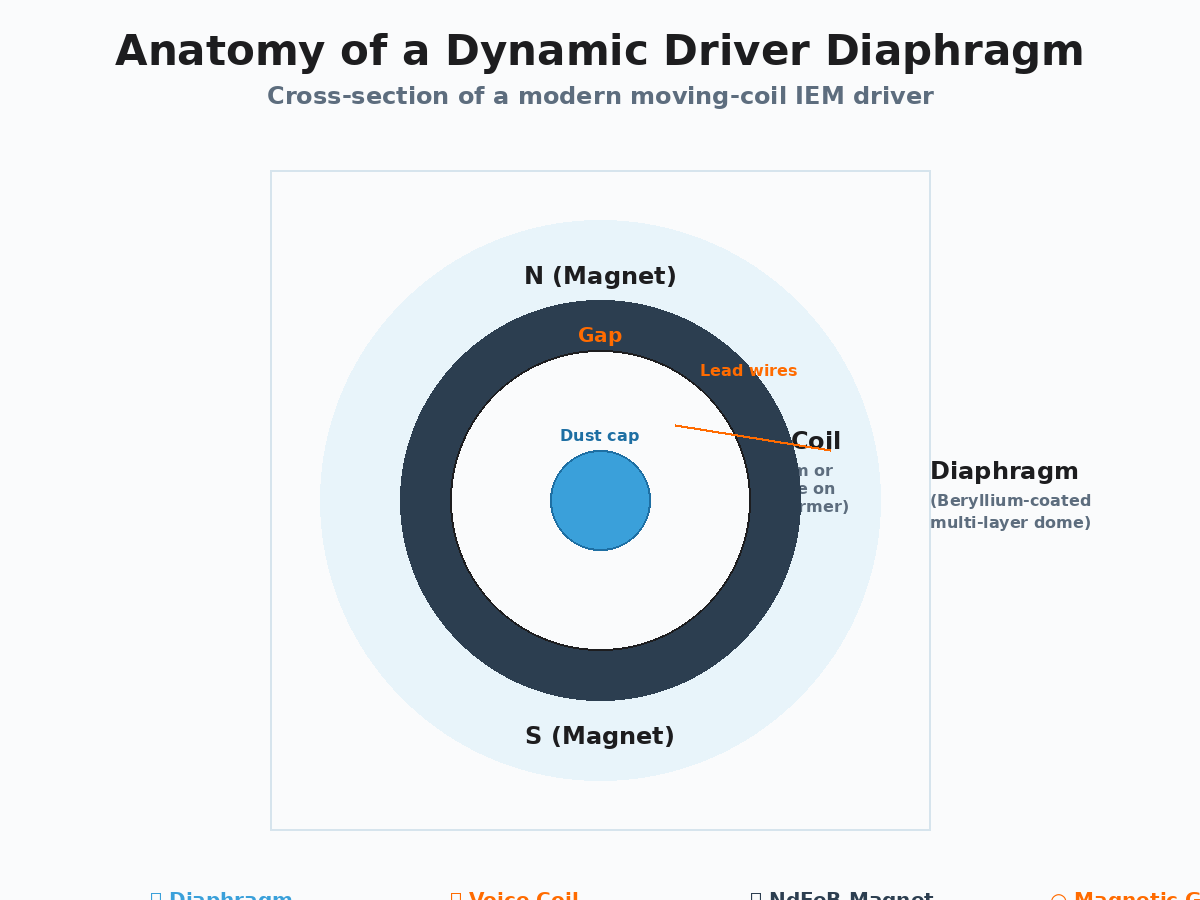
When electrical audio signal flows through the voice coil, it creates a varying magnetic field that interacts with the permanent magnet’s field. The resulting force pushes and pulls the voice coil (and attached diaphragm) back and forth at the audio frequency rate. The diaphragm moves air, creating sound waves.
Material matters because: When the diaphragm moves at high frequencies, it can develop breakup modes — areas of the diaphragm that vibrate out of phase with each other, creating distortion and dips/peaks in frequency response. Stiffer materials resist breakup, extending usable frequency response. Damped materials smooth out residual vibrations.
4. Modern Material Comparison: Stiffness, Damping, and Real-World Performance
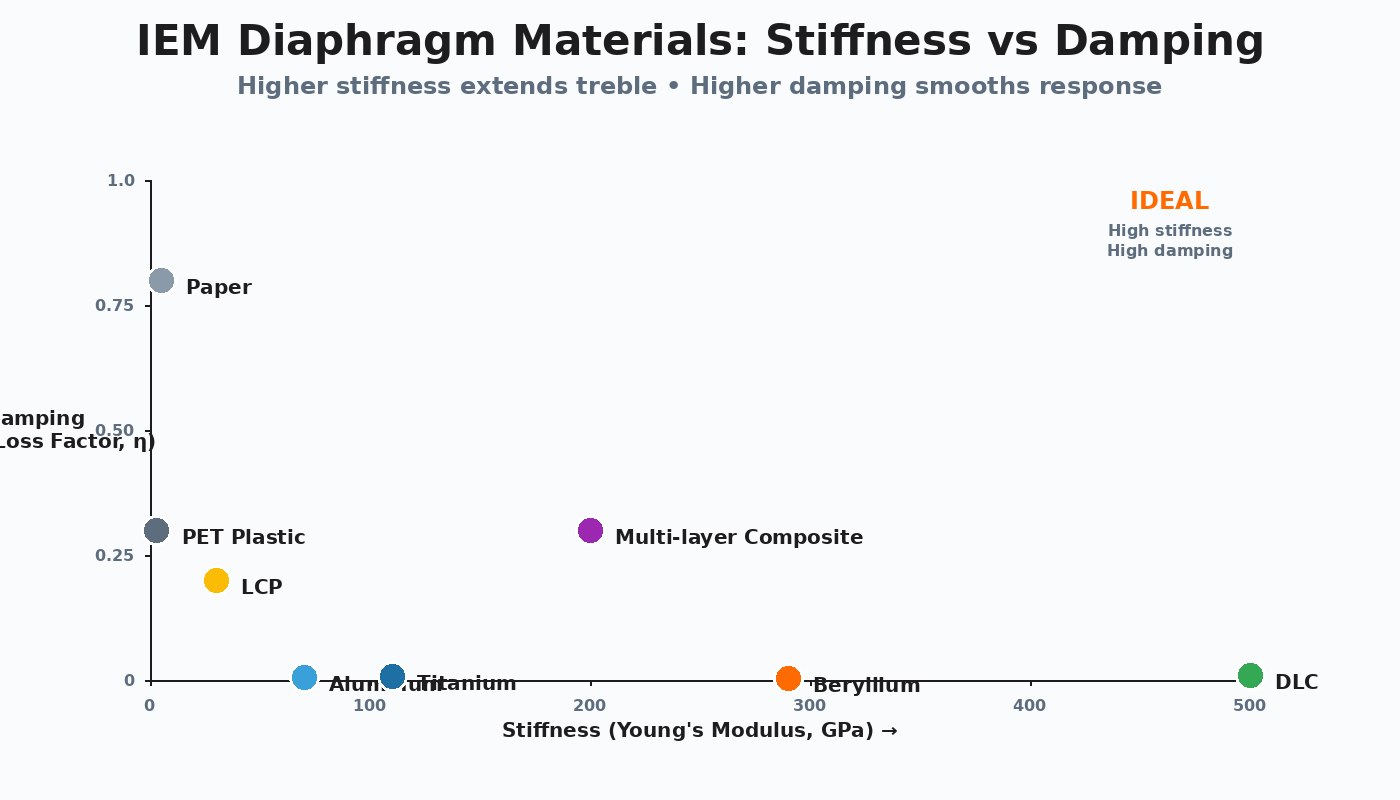
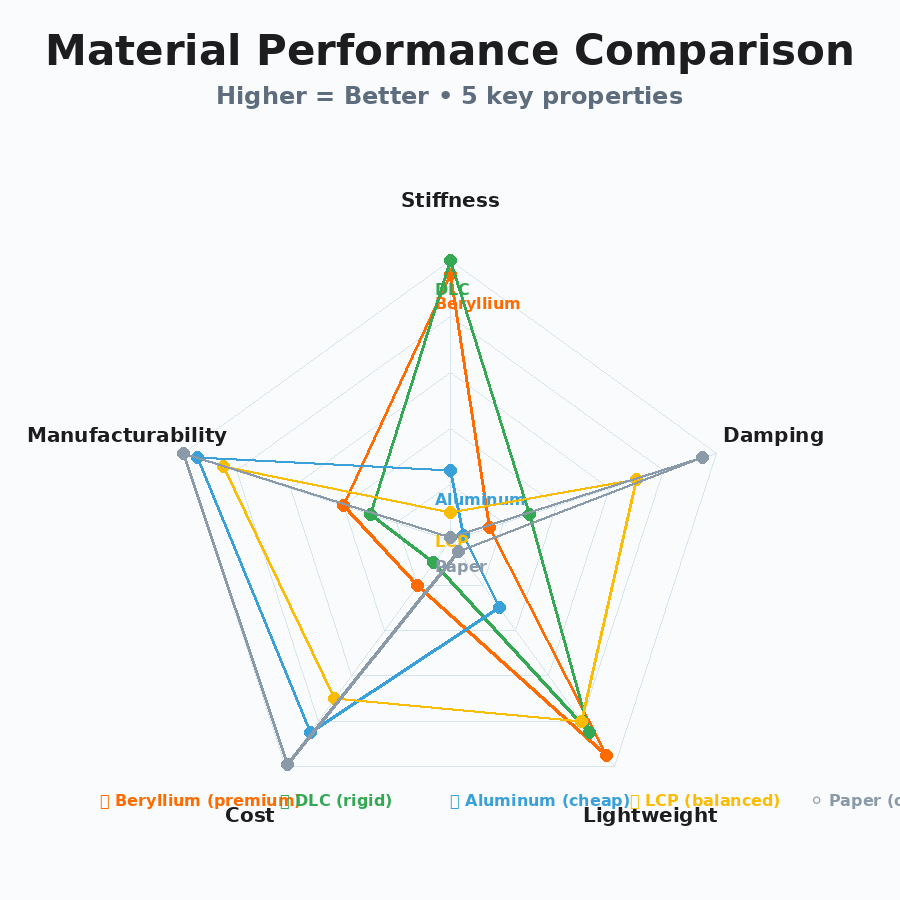
Here’s how the major diaphragm materials stack up on the metrics that actually matter:
4.1 Why Multi-Layer Composites Dominate Today
The “multi-layer sandwich” diaphragm — typically a stiff skin (beryllium or DLC, ~5 microns) bonded to a damping core (LCP or polymer, ~10 microns) — represents the industry’s answer to the stiffness-damping tradeoff. By combining materials, you get both:
- Stiff skin: Extends treble response past 20kHz
- Damping core: Controls breakup modes and ringing
- Outer coating: Protects against humidity and oxidation
This is why “beryllium-coated multi-layer dome” has become the default marketing phrase for $200+ IEMs — it’s the current best-practice design, not because beryllium coating is revolutionary, but because the multi-layer structure genuinely solves real engineering problems.
5. The Magnetic Circuit: An Equally Important Evolution
While diaphragm materials get the marketing attention, magnetic circuit evolution has been equally important. The magnet creates the field that drives the voice coil.
Modern premium IEMs use NdFeB (Neodymium-Iron-Boron) magnets, commercialized by General Motors and Sumitomo in 1984. Today’s premium IEMs use N48-N52 grade magnets (where N52 is the highest standard commercial grade). Higher grades mean stronger magnetic flux in a smaller space, which translates to:
- Higher sensitivity (louder per milliwatt)
- Better damping (motor strength controls diaphragm stop behavior)
- Lower distortion (more linear motor force)
“Dual magnetic circuits” or “high-flux neodymium arrays” — both common in current marketing — describe two NdFeB magnets stacked or arranged to concentrate flux in the voice coil gap. It’s effective engineering, but it’s also been standard practice for 20+ years.
6. Where Diaphragm Technology Is Actually Going
Real innovation in IEM diaphragms is happening in three areas brands don’t heavily market:
- Graphene coatings: Single-atom-thick carbon layers with extreme stiffness and damping. Still emerging in 2026, but expected to reach premium IEMs by 2027-2028.
- Bio-composite materials: Natural fiber composites (cellulose nanofibrils, bacterial cellulose) with surprisingly good acoustic properties and lower environmental impact.
- 3D-printed optimized diaphragms: Variable thickness profiles impossible to achieve with traditional stamping. Still R&D-stage.
These are real material innovations — not repackaging. Watch for IEMs launched in 2027-2028 that genuinely push beyond the current “beryllium multi-layer” paradigm.
7. What to Look for When Buying
Diaphragm material is just one part of the IEM sound. Here’s how to evaluate it:
- Don’t pay premium just for “beryllium” labeling. Many $50 IEMs use the same beryllium coating process as $500 IEMs — what changes is the acoustic chamber, tuning, and QC.
- Measurements matter more than materials. A well-tuned IEM with aluminum diaphragm will outperform a poorly-tuned beryllium IEM every time.
- Check the multi-layer structure. If a $300+ IEM uses a single-material diaphragm, ask why — the multi-layer sandwich is now standard for good reason.
- Read reviews that measure. Reviewers like Resolve Reviews, crinacle, and PrecogVision publish frequency response measurements — these tell you more than any diaphragm marketing.
🎧 Tuned With Real Audiophiles, Not Marketing
At XCHIFI, we don’t sell diaphragms — we deliver great sound. Browse our community-driven IEM projects, where tuning and measurements matter more than marketing buzzwords.
View Active Campaigns →Frequently Asked Questions
What is the best IEM diaphragm material?
There is no single “best” material — it depends on what you’re optimizing for. Beryllium offers the highest stiffness-to-weight ratio. DLC offers extreme stiffness. LCP offers excellent damping. Multi-layer composites attempt to combine the best of all three.
Is beryllium in IEMs dangerous?
Beryllium is toxic in dust form (berylliosis is a serious lung disease). However, solid beryllium diaphragms are sealed inside the IEM shell and pose no inhalation risk during normal use. Manufacturing beryllium diaphragms requires specialized facilities to protect workers from dust.
Are all “beryllium” IEMs the same?
No. “Beryllium” in marketing usually means beryllium coating (a few microns thick) on a substrate of aluminum, polymer, or other material. True pure beryllium diaphragms are rare due to brittleness and manufacturing difficulty. The coating thickness and substrate material significantly affect performance.
Will my IEM’s diaphragm wear out?
Quality IEM diaphragms last decades under normal use. The most common failure modes are cable damage (replaceable) and housing cracks (from drops). The diaphragm itself rarely wears out.
Does diaphragm material affect sound signature?
Yes, but less than tuning and chamber design. A beryllium driver might extend treble slightly more than aluminum, but the housing acoustics and crossover network usually have 10x more impact on the final sound.
Material property values cited (Young’s modulus, density, loss factor) are based on standard engineering references and manufacturer datasheets. Exact values vary by formulation, manufacturing process, and measurement method. Specifications reflect industry knowledge as of 2026.
2.3 1990s-2000s: Titanium and Beryllium (Premium Era Begins)
Titanium offered higher stiffness than aluminum but similar damping problems. Then came beryllium — the stiffness champion. Pure beryllium is 290 GPa Young’s modulus, 1.85 g/cm³ density — the highest specific stiffness of any metal. NASA’s aerospace applications had used it for decades. By the mid-2000s, beryllium diaphragms appeared in flagship IEMs.
But pure beryllium is brittle and difficult to manufacture — the cracking rate during diaphragm forming was extremely high. So most “beryllium” IEMs today actually use beryllium-coated aluminum or polymer substrates: a thin beryllium layer (a few microns) on top of a base material. This is the “beryllium dome” you’ll see in 90% of premium IEMs since 2015.
2.4 2008-Present: LCP, DLC, and Multi-Layer Composites
The current era has focused on combining materials rather than finding one perfect material:
- LCP (Liquid Crystal Polymer, ~2008+): Excellent damping, decent stiffness. Used in Sony MDR-Z1R (2016) and many modern IEMs.
- DLC (Diamond-Like Carbon, ~2012+): Extremely high stiffness (500+ GPa), low mass. Pioneered by Sennheiser in IE800 (2012), now used by Sennheiser, Beyerdynamic, and others.
- Multi-layer sandwich (2018+): Two or three thin layers bonded together — a stiff skin + damping core + protective coating. The current “premium” structure in most $200+ IEMs.
- Bio-cellulose (emerging): Natural fiber composite, similar properties to LCP. Marketed as “eco-friendly” but mostly equivalent to LCP.
3. Anatomy of a Modern Dynamic Driver
To understand why materials matter, let’s see how a diaphragm works in a real IEM driver:
When electrical audio signal flows through the voice coil, it creates a varying magnetic field that interacts with the permanent magnet’s field. The resulting force pushes and pulls the voice coil (and attached diaphragm) back and forth at the audio frequency rate. The diaphragm moves air, creating sound waves.
Material matters because: When the diaphragm moves at high frequencies, it can develop breakup modes — areas of the diaphragm that vibrate out of phase with each other, creating distortion and dips/peaks in frequency response. Stiffer materials resist breakup, extending usable frequency response. Damped materials smooth out residual vibrations.
4. Modern Material Comparison: Stiffness, Damping, and Real-World Performance
Here’s how the major diaphragm materials stack up on the metrics that actually matter:
4.1 Why Multi-Layer Composites Dominate Today
The “multi-layer sandwich” diaphragm — typically a stiff skin (beryllium or DLC, ~5 microns) bonded to a damping core (LCP or polymer, ~10 microns) — represents the industry’s answer to the stiffness-damping tradeoff. By combining materials, you get both:
- Stiff skin: Extends treble response past 20kHz
- Damping core: Controls breakup modes and ringing
- Outer coating: Protects against humidity and oxidation
This is why “beryllium-coated multi-layer dome” has become the default marketing phrase for $200+ IEMs — it’s the current best-practice design, not because beryllium coating is revolutionary, but because the multi-layer structure genuinely solves real engineering problems.
5. The Magnetic Circuit: An Equally Important Evolution
While diaphragm materials get the marketing attention, magnetic circuit evolution has been equally important. The magnet creates the field that drives the voice coil.
Modern premium IEMs use NdFeB (Neodymium-Iron-Boron) magnets, commercialized by General Motors and Sumitomo in 1984. Today’s premium IEMs use N48-N52 grade magnets (where N52 is the highest standard commercial grade). Higher grades mean stronger magnetic flux in a smaller space, which translates to:
- Higher sensitivity (louder per milliwatt)
- Better damping (motor strength controls diaphragm stop behavior)
- Lower distortion (more linear motor force)
“Dual magnetic circuits” or “high-flux neodymium arrays” — both common in current marketing — describe two NdFeB magnets stacked or arranged to concentrate flux in the voice coil gap. It’s effective engineering, but it’s also been standard practice for 20+ years.
6. Where Diaphragm Technology Is Actually Going
Real innovation in IEM diaphragms is happening in three areas brands don’t heavily market:
- Graphene coatings: Single-atom-thick carbon layers with extreme stiffness and damping. Still emerging in 2026, but expected to reach premium IEMs by 2027-2028.
- Bio-composite materials: Natural fiber composites (cellulose nanofibrils, bacterial cellulose) with surprisingly good acoustic properties and lower environmental impact.
- 3D-printed optimized diaphragms: Variable thickness profiles impossible to achieve with traditional stamping. Still R&D-stage.
These are real material innovations — not repackaging. Watch for IEMs launched in 2027-2028 that genuinely push beyond the current “beryllium multi-layer” paradigm.
7. What to Look for When Buying
Diaphragm material is just one part of the IEM sound. Here’s how to evaluate it:
- Don’t pay premium just for “beryllium” labeling. Many $50 IEMs use the same beryllium coating process as $500 IEMs — what changes is the acoustic chamber, tuning, and QC.
- Measurements matter more than materials. A well-tuned IEM with aluminum diaphragm will outperform a poorly-tuned beryllium IEM every time.
- Check the multi-layer structure. If a $300+ IEM uses a single-material diaphragm, ask why — the multi-layer sandwich is now standard for good reason.
- Read reviews that measure. Reviewers like Resolve Reviews, crinacle, and PrecogVision publish frequency response measurements — these tell you more than any diaphragm marketing.
🎧 Tuned With Real Audiophiles, Not Marketing
At XCHIFI, we don’t sell diaphragms — we deliver great sound. Browse our community-driven IEM projects, where tuning and measurements matter more than marketing buzzwords.
View Active Campaigns →Frequently Asked Questions
What is the best IEM diaphragm material?
There is no single “best” material — it depends on what you’re optimizing for. Beryllium offers the highest stiffness-to-weight ratio. DLC offers extreme stiffness. LCP offers excellent damping. Multi-layer composites attempt to combine the best of all three.
Is beryllium in IEMs dangerous?
Beryllium is toxic in dust form (berylliosis is a serious lung disease). However, solid beryllium diaphragms are sealed inside the IEM shell and pose no inhalation risk during normal use. Manufacturing beryllium diaphragms requires specialized facilities to protect workers from dust.
Are all “beryllium” IEMs the same?
No. “Beryllium” in marketing usually means beryllium coating (a few microns thick) on a substrate of aluminum, polymer, or other material. True pure beryllium diaphragms are rare due to brittleness and manufacturing difficulty. The coating thickness and substrate material significantly affect performance.
Will my IEM’s diaphragm wear out?
Quality IEM diaphragms last decades under normal use. The most common failure modes are cable damage (replaceable) and housing cracks (from drops). The diaphragm itself rarely wears out.
Does diaphragm material affect sound signature?
Yes, but less than tuning and chamber design. A beryllium driver might extend treble slightly more than aluminum, but the housing acoustics and crossover network usually have 10x more impact on the final sound.
Material property values cited (Young’s modulus, density, loss factor) are based on standard engineering references and manufacturer datasheets. Exact values vary by formulation, manufacturing process, and measurement method. Specifications reflect industry knowledge as of 2026.
From Paper to Beryllium: The Evolution of IEM Diaphragm Materials (1925–2026)
Last updated: September 2026 · Reading time: 16 minutes · By: XCHIFI Engineering Team
If you’ve read a single IEM advertisement in the last five years, you’ve seen the words: “beryllium-coated,” “DLC dome,” “multi-layer composite.” Every brand promises their diaphragm material is the next breakthrough. But what’s actually happening inside that tiny driver — and what’s just marketing repackaging of decades-old engineering?
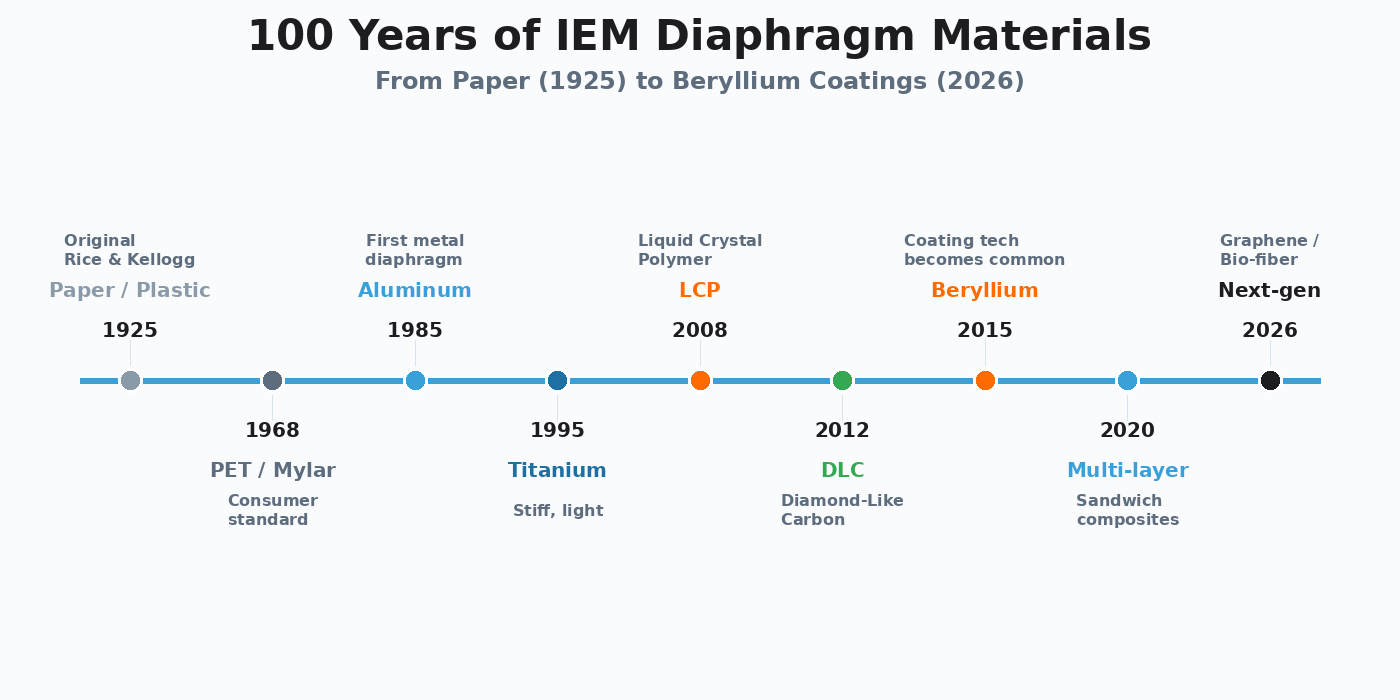
In this article, we trace the full 100-year evolution of dynamic driver diaphragm materials — from the paper cones of 1925 to the multi-layer sandwich structures of 2026 — with the engineering tradeoffs that actually matter.
1. Why Diaphragm Materials Matter
The diaphragm is the heart of any dynamic driver — a thin membrane that vibrates to create sound. Three properties define its performance:
- Stiffness (Young’s Modulus): Higher stiffness = the diaphragm doesn’t bend or “break up” at high frequencies. Stiffer diaphragms extend treble response.
- Damping (Internal Loss): Higher damping = the diaphragm stops vibrating cleanly after each sound impulse. Damped diaphragms sound smoother with less ringing.
- Mass (Density): Lower mass = faster transient response. Lighter diaphragms respond quicker to musical details.
The fundamental engineering challenge: no material is best at all three. Stiff materials tend to be poorly damped. Well-damped materials tend to be soft. Lightweight materials tend to be floppy. Every diaphragm material is a compromise.
2. The 100-Year Timeline: What Actually Changed When
2.1 1925-1950s: Paper and Plastic (The Original)
The moving-coil driver invented by Chester W. Rice and Edward W. Kellogg at General Electric in 1925 used paper cones. Paper is highly damped but floppy and heavy. By the 1950s, plastic films (PET, Mylar) began replacing paper in headphones, and dominated consumer IEMs through the 1990s. PET is cheap, easy to manufacture, and has reasonable damping — but its low stiffness limits treble extension.
2.2 1985-1990s: Aluminum — The First Metal Diaphragm
Aluminum was the first metal used in IEM diaphragms (mid-1980s in over-ear; 1990s in IEMs). It’s stiff (70 GPa) and lightweight (2.7 g/cm³), extending treble significantly. But aluminum is also poorly damped — aluminum diaphragms tend to sound metallic with audible resonances around 5-8kHz. You can hear this in older IEMs from Sony and JVC.
2.3 1990s-2000s: Titanium and Beryllium (Premium Era Begins)
Titanium offered higher stiffness than aluminum but similar damping problems. Then came beryllium — the stiffness champion. Pure beryllium is 290 GPa Young’s modulus, 1.85 g/cm³ density — the highest specific stiffness of any metal. NASA’s aerospace applications had used it for decades. By the mid-2000s, beryllium diaphragms appeared in flagship IEMs.
But pure beryllium is brittle and difficult to manufacture — the cracking rate during diaphragm forming was extremely high. So most “beryllium” IEMs today actually use beryllium-coated aluminum or polymer substrates: a thin beryllium layer (a few microns) on top of a base material. This is the “beryllium dome” you’ll see in 90% of premium IEMs since 2015.
2.4 2008-Present: LCP, DLC, and Multi-Layer Composites
The current era has focused on combining materials rather than finding one perfect material:
- LCP (Liquid Crystal Polymer, ~2008+): Excellent damping, decent stiffness. Used in Sony MDR-Z1R (2016) and many modern IEMs.
- DLC (Diamond-Like Carbon, ~2012+): Extremely high stiffness (500+ GPa), low mass. Pioneered by Sennheiser in IE800 (2012), now used by Sennheiser, Beyerdynamic, and others.
- Multi-layer sandwich (2018+): Two or three thin layers bonded together — a stiff skin + damping core + protective coating. The current “premium” structure in most $200+ IEMs.
- Bio-cellulose (emerging): Natural fiber composite, similar properties to LCP. Marketed as “eco-friendly” but mostly equivalent to LCP.
3. Anatomy of a Modern Dynamic Driver
To understand why materials matter, let’s see how a diaphragm works in a real IEM driver:
When electrical audio signal flows through the voice coil, it creates a varying magnetic field that interacts with the permanent magnet’s field. The resulting force pushes and pulls the voice coil (and attached diaphragm) back and forth at the audio frequency rate. The diaphragm moves air, creating sound waves.
Material matters because: When the diaphragm moves at high frequencies, it can develop breakup modes — areas of the diaphragm that vibrate out of phase with each other, creating distortion and dips/peaks in frequency response. Stiffer materials resist breakup, extending usable frequency response. Damped materials smooth out residual vibrations.
4. Modern Material Comparison: Stiffness, Damping, and Real-World Performance
Here’s how the major diaphragm materials stack up on the metrics that actually matter:
4.1 Why Multi-Layer Composites Dominate Today
The “multi-layer sandwich” diaphragm — typically a stiff skin (beryllium or DLC, ~5 microns) bonded to a damping core (LCP or polymer, ~10 microns) — represents the industry’s answer to the stiffness-damping tradeoff. By combining materials, you get both:
- Stiff skin: Extends treble response past 20kHz
- Damping core: Controls breakup modes and ringing
- Outer coating: Protects against humidity and oxidation
This is why “beryllium-coated multi-layer dome” has become the default marketing phrase for $200+ IEMs — it’s the current best-practice design, not because beryllium coating is revolutionary, but because the multi-layer structure genuinely solves real engineering problems.
5. The Magnetic Circuit: An Equally Important Evolution
While diaphragm materials get the marketing attention, magnetic circuit evolution has been equally important. The magnet creates the field that drives the voice coil.
Modern premium IEMs use NdFeB (Neodymium-Iron-Boron) magnets, commercialized by General Motors and Sumitomo in 1984. Today’s premium IEMs use N48-N52 grade magnets (where N52 is the highest standard commercial grade). Higher grades mean stronger magnetic flux in a smaller space, which translates to:
- Higher sensitivity (louder per milliwatt)
- Better damping (motor strength controls diaphragm stop behavior)
- Lower distortion (more linear motor force)
“Dual magnetic circuits” or “high-flux neodymium arrays” — both common in current marketing — describe two NdFeB magnets stacked or arranged to concentrate flux in the voice coil gap. It’s effective engineering, but it’s also been standard practice for 20+ years.
6. Where Diaphragm Technology Is Actually Going
Real innovation in IEM diaphragms is happening in three areas brands don’t heavily market:
- Graphene coatings: Single-atom-thick carbon layers with extreme stiffness and damping. Still emerging in 2026, but expected to reach premium IEMs by 2027-2028.
- Bio-composite materials: Natural fiber composites (cellulose nanofibrils, bacterial cellulose) with surprisingly good acoustic properties and lower environmental impact.
- 3D-printed optimized diaphragms: Variable thickness profiles impossible to achieve with traditional stamping. Still R&D-stage.
These are real material innovations — not repackaging. Watch for IEMs launched in 2027-2028 that genuinely push beyond the current “beryllium multi-layer” paradigm.
7. What to Look for When Buying
Diaphragm material is just one part of the IEM sound. Here’s how to evaluate it:
- Don’t pay premium just for “beryllium” labeling. Many $50 IEMs use the same beryllium coating process as $500 IEMs — what changes is the acoustic chamber, tuning, and QC.
- Measurements matter more than materials. A well-tuned IEM with aluminum diaphragm will outperform a poorly-tuned beryllium IEM every time.
- Check the multi-layer structure. If a $300+ IEM uses a single-material diaphragm, ask why — the multi-layer sandwich is now standard for good reason.
- Read reviews that measure. Reviewers like Resolve Reviews, crinacle, and PrecogVision publish frequency response measurements — these tell you more than any diaphragm marketing.
🎧 Tuned With Real Audiophiles, Not Marketing
At XCHIFI, we don’t sell diaphragms — we deliver great sound. Browse our community-driven IEM projects, where tuning and measurements matter more than marketing buzzwords.
View Active Campaigns →Frequently Asked Questions
What is the best IEM diaphragm material?
There is no single “best” material — it depends on what you’re optimizing for. Beryllium offers the highest stiffness-to-weight ratio. DLC offers extreme stiffness. LCP offers excellent damping. Multi-layer composites attempt to combine the best of all three.
Is beryllium in IEMs dangerous?
Beryllium is toxic in dust form (berylliosis is a serious lung disease). However, solid beryllium diaphragms are sealed inside the IEM shell and pose no inhalation risk during normal use. Manufacturing beryllium diaphragms requires specialized facilities to protect workers from dust.
Are all “beryllium” IEMs the same?
No. “Beryllium” in marketing usually means beryllium coating (a few microns thick) on a substrate of aluminum, polymer, or other material. True pure beryllium diaphragms are rare due to brittleness and manufacturing difficulty. The coating thickness and substrate material significantly affect performance.
Will my IEM’s diaphragm wear out?
Quality IEM diaphragms last decades under normal use. The most common failure modes are cable damage (replaceable) and housing cracks (from drops). The diaphragm itself rarely wears out.
Does diaphragm material affect sound signature?
Yes, but less than tuning and chamber design. A beryllium driver might extend treble slightly more than aluminum, but the housing acoustics and crossover network usually have 10x more impact on the final sound.
Material property values cited (Young’s modulus, density, loss factor) are based on standard engineering references and manufacturer datasheets. Exact values vary by formulation, manufacturing process, and measurement method. Specifications reflect industry knowledge as of 2026.