
IEM Buying Guide 2026: How to Choose Your First In-Ear Monitor
Last updated: September 2026 · Reading time: 15 minutes · By: XCHIFI Engineering Team
Buying your first audiophile IEM can feel overwhelming. There are thousands of models across hundreds of brands, with prices ranging from $20 to $4,000+. Marketing claims are everywhere. Specs look identical. Reviews contradict each other.
This guide cuts through the noise. By the end, you’ll know exactly which IEM category fits your needs, your budget, and your source equipment — without falling for marketing hype.
1. The 5-Step Decision Framework
Before looking at any specific IEM, answer these 5 questions. They’ll narrow down your choices from thousands to dozens.
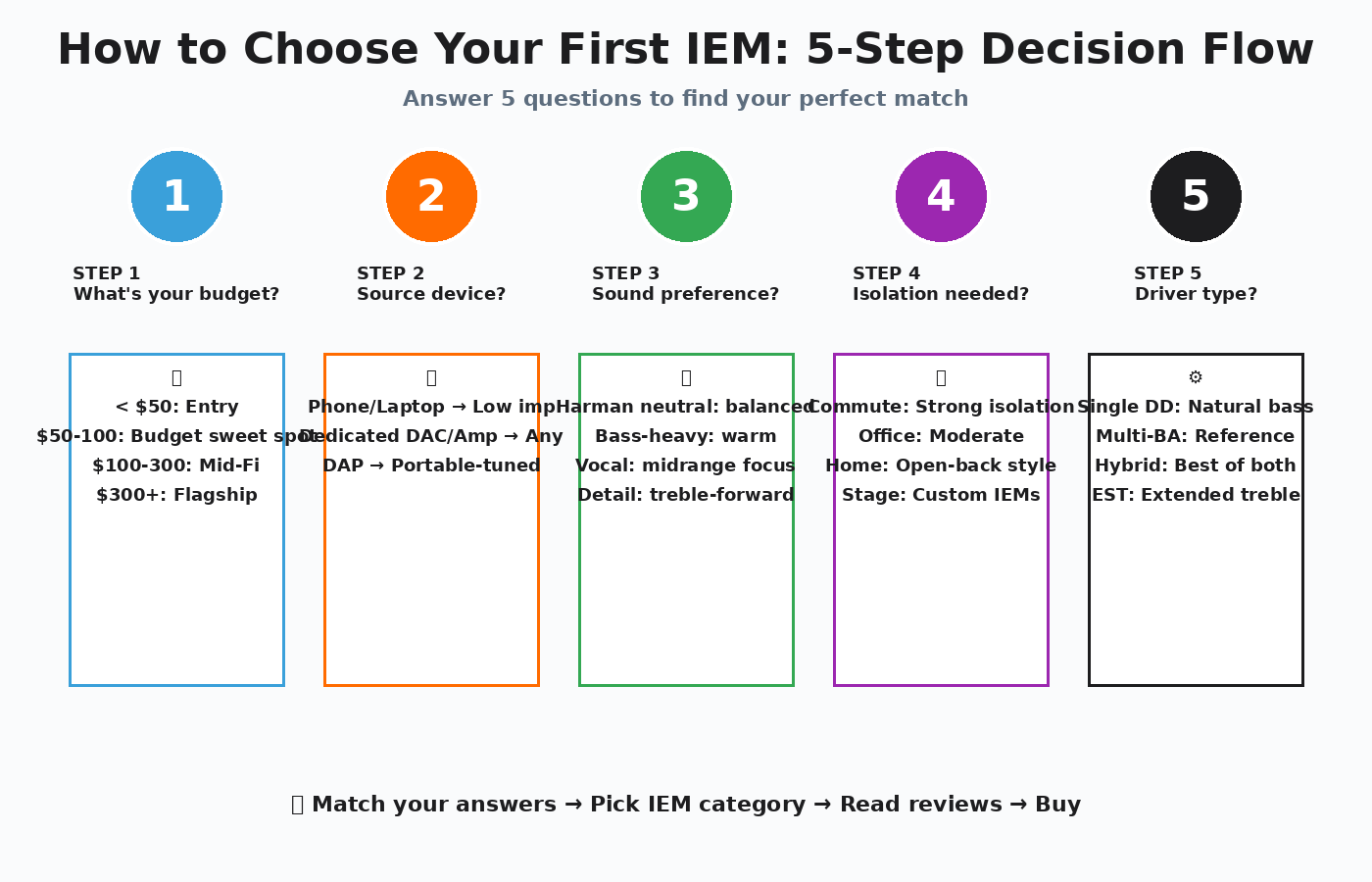
Step 1: What’s Your Budget?
Realistic expectations for each price tier. Be honest with yourself — paying more doesn’t automatically mean better sound if you’re not ready for it.
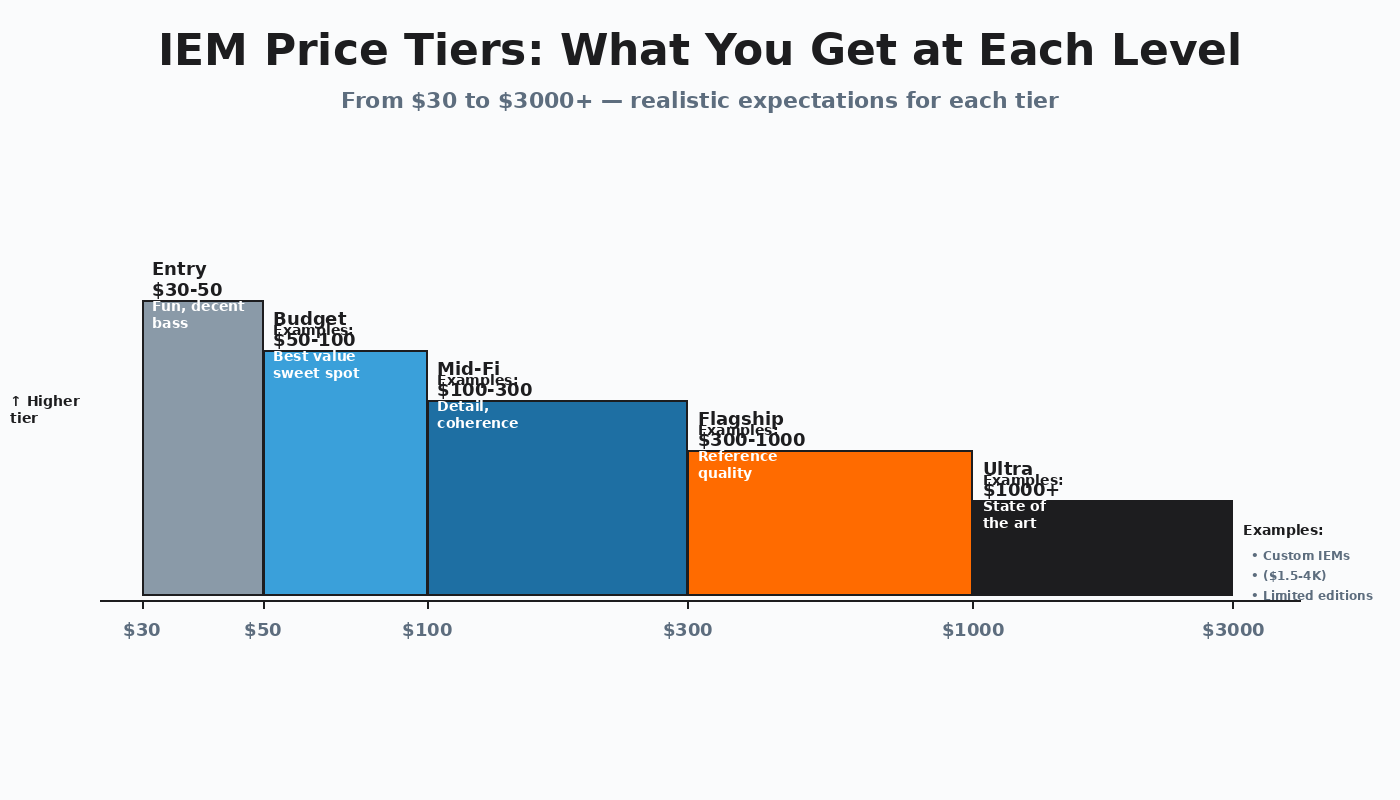
- $30-50 (Entry): Pleasant sound, basic build quality. Great for testing if IEMs work for you.
- $50-100 (Budget sweet spot): Best value. Modern tunings, good detail, solid build.
- $100-300 (Mid-Fi): Audible step up in detail, separation, and refinement.
- $300-1000 (Flagship): Reference-quality tuning, premium materials, excellent QC.
- $1000+ (Ultra / Custom): State-of-the-art. For those who have already learned what they want.
Step 2: What’s Your Source?
Different IEMs have different impedance and sensitivity, which affects how easy they are to drive from different sources.
- Phone / Laptop (no separate DAC): Look for impedance under 32Ω, sensitivity above 100 dB/mW
- USB DAC dongle ($20-100): Same as above — most modern dongles handle 16-300Ω IEMs well
- Dedicated desktop amp: Can drive anything, including high-impedance planars
- DAP (Digital Audio Player): Match IEM impedance to DAP output impedance for best results
Rule of thumb: If you are using just a phone, stick with IEMs under 50Ω. Higher-impedance IEMs will play quieter and may sound thin.
Step 3: What’s Your Sound Preference?
Modern IEMs are tuned to specific target curves. Know your preference before shopping.
- Harman Neutral (most popular): Slight bass emphasis, gently rolled-off treble. The “objectively good” tuning per Harman research.
- Diffuse-Field (studio reference): Flat, balanced. Best for audio professionals and critical listening.
- Bass-Heavy / Warm: Elevated bass and lower mids. Great for EDM, hip-hop, pop.
- Vocal-Forward: Midrange emphasis. Best for podcasts, vocals, acoustic music.
- Bright / Analytical: Treble-forward. Detail retrieval, but can be fatiguing.
Not sure? Start with Harman-neutral — it is the safest tuning for first-time IEM buyers.
Step 4: How Much Isolation?
- Commute / Travel: Need strong isolation. Look for closed-back IEMs with good seal.
- Office / Quiet Home: Moderate isolation is fine.
- Stage / Live Performance: Custom IEMs (CIEMs) with deep insertion offer best isolation.
Step 5: Driver Type?
- Single Dynamic Driver: Natural, cohesive sound. Excellent bass. Best for beginners.
- Multiple Balanced Armatures: Reference precision. Best for studio work.
- Hybrid (DD + BA): Combines bass impact + treble detail.
- EST (Electrostatic): Extended treble. Almost always paired with other drivers.
For your first IEM, single dynamic driver is the simplest, most reliable choice.
2. Top Picks for First-Time IEM Buyers
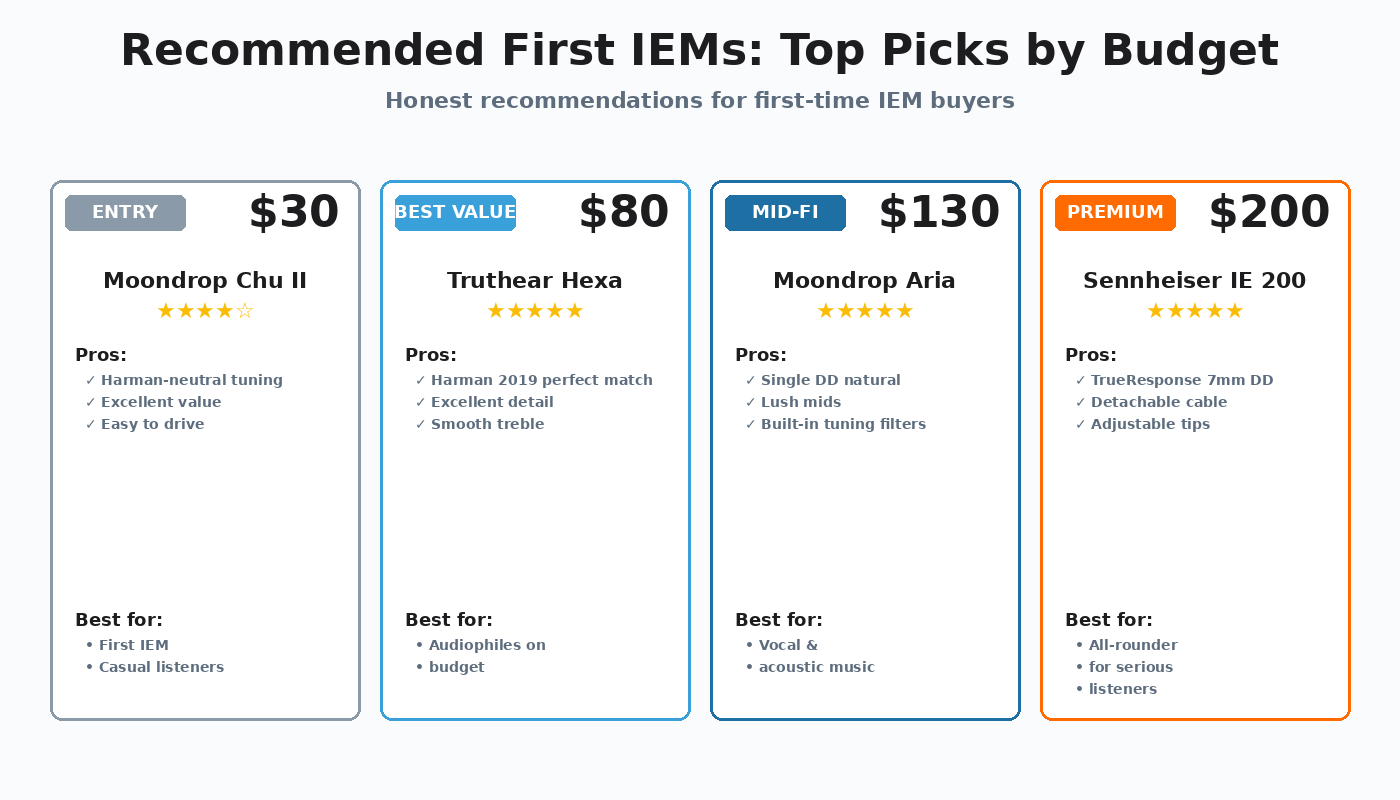
After answering the 5 questions, here are our honest recommendations for the most common buyer profiles. All models below are well-reviewed, measure to target curves accurately, and represent good value at their price points.
2.1 Under $50: Moondrop Chu II
The Moondrop Chu II ($30-40) is widely considered the best sub-$50 IEM in 2026. Harman-neutral tuning done right, with surprisingly refined treble for the price. Single dynamic driver, easy to drive from any phone.
- Pros: Excellent tuning • Small and comfortable • Universal compatibility
- Cons: Cable is fixed (not detachable) • Limited bass depth
- Best for: First-time IEM buyers, casual listeners
2.2 $50-100: Truthear Hexa
The Truthear Hexa ($80) is the modern benchmark for the budget sweet spot. Harman 2019 compliant with hybrid DD + 3 BA drivers, delivering detail and coherence rarely seen under $100.
- Pros: Reference tuning • Smooth treble • Detachable cable
- Cons: Requires decent source for optimal volume
- Best for: Audiophiles on budget, value seekers
2.3 $100-200: Moondrop Aria
The Moondrop Aria ($130) is a single dynamic driver masterpiece. Lush mids, natural tonality, and Moondrop signature “harman with warmth” tuning. Built-in tuning filters let you adjust the signature.
- Pros: Coherent single-DD sound • Lush vocals • Tuning filters
- Cons: Not the most bass-heavy option
- Best for: Vocal and acoustic music lovers
2.4 $200-300: Sennheiser IE 200
The Sennheiser IE 200 ($200) brings Sennheiser 7mm TrueResponse dynamic driver technology to the sub-$300 range. Detailed but smooth, with adjustable ear tip fit for personalized sound.
- Pros: Premium driver tech • Detachable cable • Adjustable fit
- Cons: Stock tips need experimentation
- Best for: All-rounder for serious listeners
3. Common First-Time Buyer Mistakes
After helping thousands of first-time IEM buyers, here are the most common mistakes to avoid:
3.1 Spending Too Much Too Early
Do not start with a $1,000 IEM. Your ears need 2-3 months of daily listening to develop reference points. Start with a $80-150 IEM, use it for 6 months, then upgrade — you will appreciate the higher-end IEM much more.
3.2 Ignoring Fit and Tips
The best IEM in the world sounds terrible with a bad seal. Most IEMs ship with stock tips that do not fit everyone. Budget $15-30 for aftermarket tips (SpinFit, AZLA, Final E-Type) — they can transform your IEM sound.
3.3 Trusting Specs Over Measurements
Manufacturer specs are often misleading or measured under ideal conditions. Independent measurements (Resolve Reviews, crinacle, PrecogVision) are far more reliable than spec sheets.
3.4 Buying Without Listening
Audio is subjective. What sounds great to a reviewer might not match your preference. Look for IEM return policies (Amazon, most audiophile retailers) or audition at local meetups when possible.
4. Where to Buy
- Amazon / AliExpress: Easy returns, good selection. Watch for counterfeit sellers on AliExpress.
- Linsoul / HiFiGo / PenonAudio: Trusted audiophile retailers with good shipping worldwide.
- Manufacturer direct: Often the safest option for warranty and authenticity.
- Head-Fi classifieds: Used market for high-end IEMs at discounts.
🎧 Want a Truly Co-Created IEM?
Skip the guessing. Our community-driven IEM projects let you vote on tuning, shell design, and packaging — so the final product matches your preference, not a brand’s marketing.
Browse Active Campaigns →Frequently Asked Questions
What is a good first IEM under $100?
The Truthear Hexa ($80) is our top pick under $100. It measures accurately to the Harman 2019 target, has a hybrid DD + 3 BA driver setup, and represents exceptional value for the price.
How much should I spend on my first IEM?
For most first-time buyers, $80-150 is the sweet spot. Below $80, you start hitting quality compromises. Above $200, you are paying for refinement that new listeners cannot appreciate yet.
Do I need a DAC/amp for IEMs?
For most modern IEMs with impedance under 32Ω, your phone headphone jack is sufficient. A USB DAC dongle ($20-50) is a worthwhile upgrade if you want cleaner sound, but it is not required for beginners.
Single DD vs multi-driver — which is better?
Neither is universally better. Single dynamic drivers typically have more natural, cohesive sound. Multi-driver designs can offer better detail and separation but require careful crossover design to avoid phase issues.
How long do IEMs last?
Quality IEMs typically last 5-10+ years with normal use. The most common failure is cable damage (often replaceable). Drivers themselves rarely fail unless exposed to physical shock or moisture.
Product recommendations reflect market availability and reviews as of 2026. Prices and availability may vary by region. Specifications cited are typical and verified through manufacturer documentation and independent reviews.