
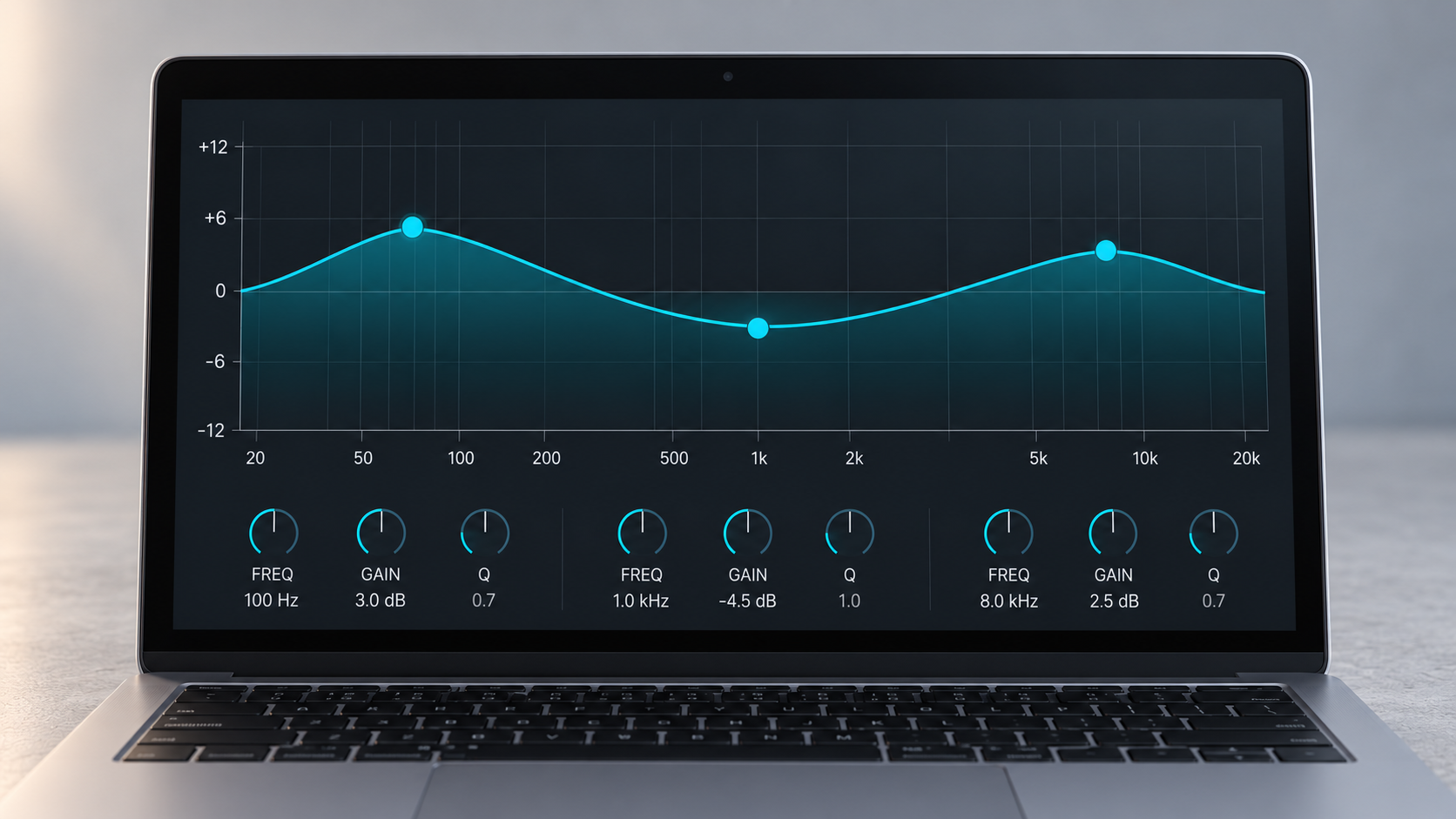
Yes, EQ can improve headphone sound by correcting tonal balance and making existing details easier to hear. It cannot create missing information or remove every hardware limitation. That applies to budget Chi-Fi IEMs and headphones from brands anywhere else.
The useful question is not whether EQ is good or bad. It is what you want to change, and how much adjustment your earphones can handle.
How does headphone EQ work?
An equalizer uses filters to raise or lower selected frequencies. Digital EQ processes the audio signal before it reaches the headphone driver. With parametric EQ, frequency selects the area, gain sets the boost or cut, and Q controls how narrow the adjustment is.
Reducing excessive bass can clear up vocals. Cutting a treble peak can soften harshness. EQ changes the signal sent to the earphones; it does not replace their drivers or acoustic chambers.
What changes when you adjust EQ?
- More bass: greater weight and impact, but excessive boost can mask vocals and increase driver demands.
- More midrange: voices may move forward, although too much can sound shouty.
- More treble: a brighter presentation that may also expose sibilance and recording noise.
Compare EQ on and off at a similar perceived volume. Louder or brighter sound is not automatically more accurate.
Can EQ improve detail and soundstage?
EQ can improve perceived clarity. Reducing an overpowering frequency region may reveal quieter sounds that were being masked. Saying that EQ can never improve detail is too absolute. However, boosting treble cannot recover information missing from a recording or repair a damaged driver.
Soundstage also depends on the recording, ear-related spatial cues, fit and acoustic design. EQ can change the impression of space, but it cannot guarantee that an IEM will sound like an open-back headphone or a pair of speakers.
A driver with limited clean bass output does not gain unlimited extension through boosting. Sonarworks explains this hardware limit: asking the driver to produce more than it can manage may increase distortion.
Does EQ cause phase shift or distortion?
Common minimum-phase equalizers change phase relationships as they change frequency response. Phase shift does not automatically mean audible damage. It is different from clipping or a driver breaking up.
Linear-phase EQ preserves relative phase relationships while introducing a common delay. Depending on its settings, it can also produce pre-ringing: a small oscillation before a sharp transient. As FabFilter’s explanation shows, neither approach is universally better.
Large boosts create another concern: digital clipping if the processed signal exceeds the available headroom. Lowering the EQ preamp helps prevent this. It does not prevent amplifier overload or driver distortion if playback is then pushed too loud. Sonarworks’ Safe Headroom documentation explains the digital gain issue.
How to EQ Chi-Fi IEMs and other headphones
- Check fit first. A poor ear-tip seal can reduce bass; a large boost is not a reliable substitute for a proper seal.
- Fix one problem at a time. Start with small adjustments, such as 1–2 dB, and listen again.
- Leave headroom. Set negative preamp gain according to the combined EQ curve, especially where boosted filters overlap.
- Back off if sound becomes rough. Reduce both the boost and playback volume if you hear breakup.
There is no universal best EQ for Chi-Fi. Model-specific tuning, fit and your preferences matter more than a brand’s country of origin. A preset is a starting point, not a promise.
Good EQ helps your headphones suit your listening. It does not make every headphone technically identical. For more background, explore our planar vs dynamic IEM guide and how IEMs are tested at the factory.
Explore more XCHIFI IEM guides and HiFi news, and discover ideas for creating better earphones together.
1 thought on “Does EQ Improve Headphone Sound? Benefits and Limits”