
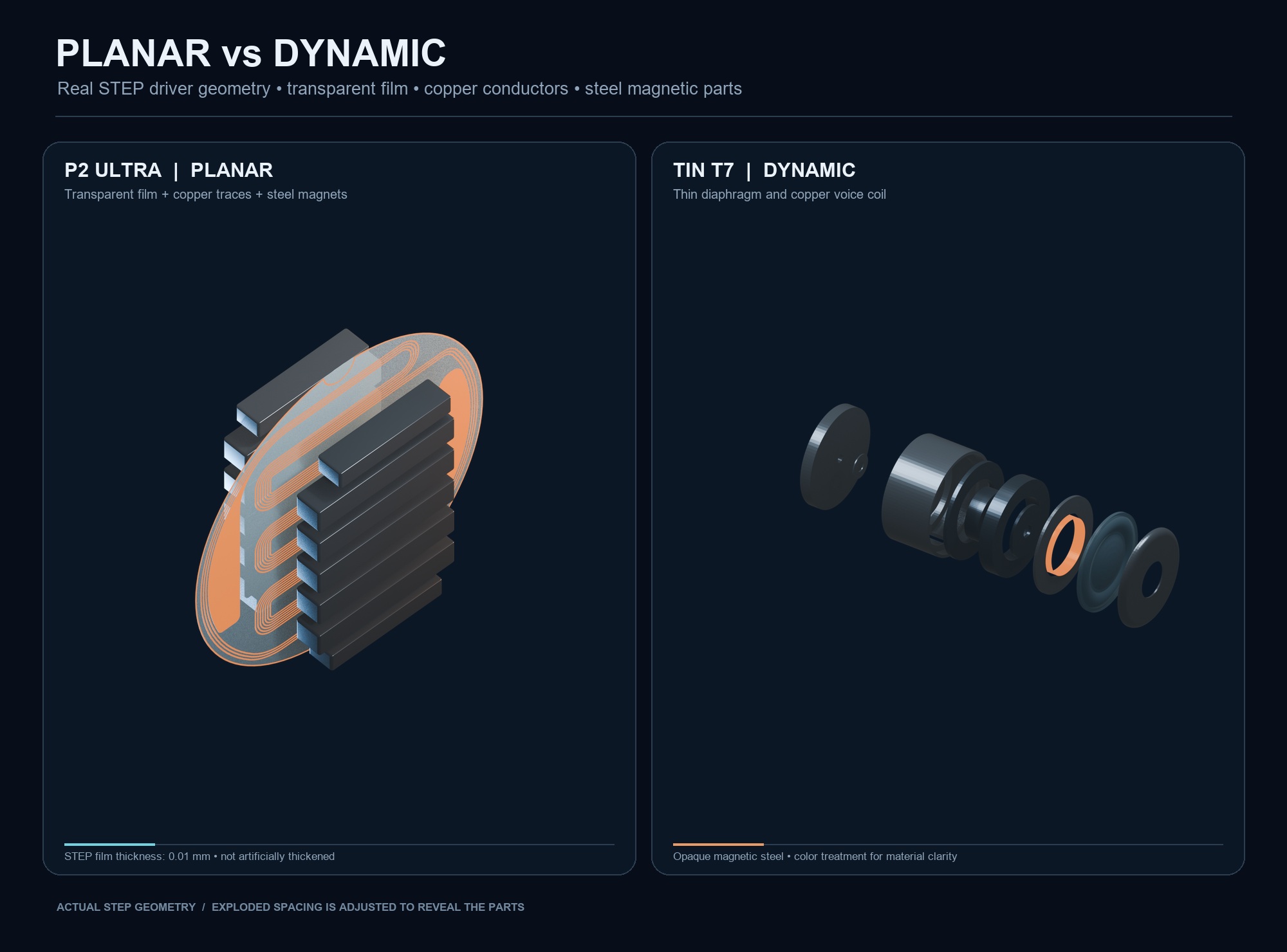
Planar and dynamic IEMs make sound in different ways, but both turn an audio signal into diaphragm motion and changing air pressure. In the P2 ULTRA planar driver, copper traces on a thin film interact with a magnetic field. In the TIN T7 dynamic driver, a voice coil attached to the diaphragm moves inside a magnetic gap. The supplied STEP models make those differences easier to see.
How the P2 ULTRA planar driver works
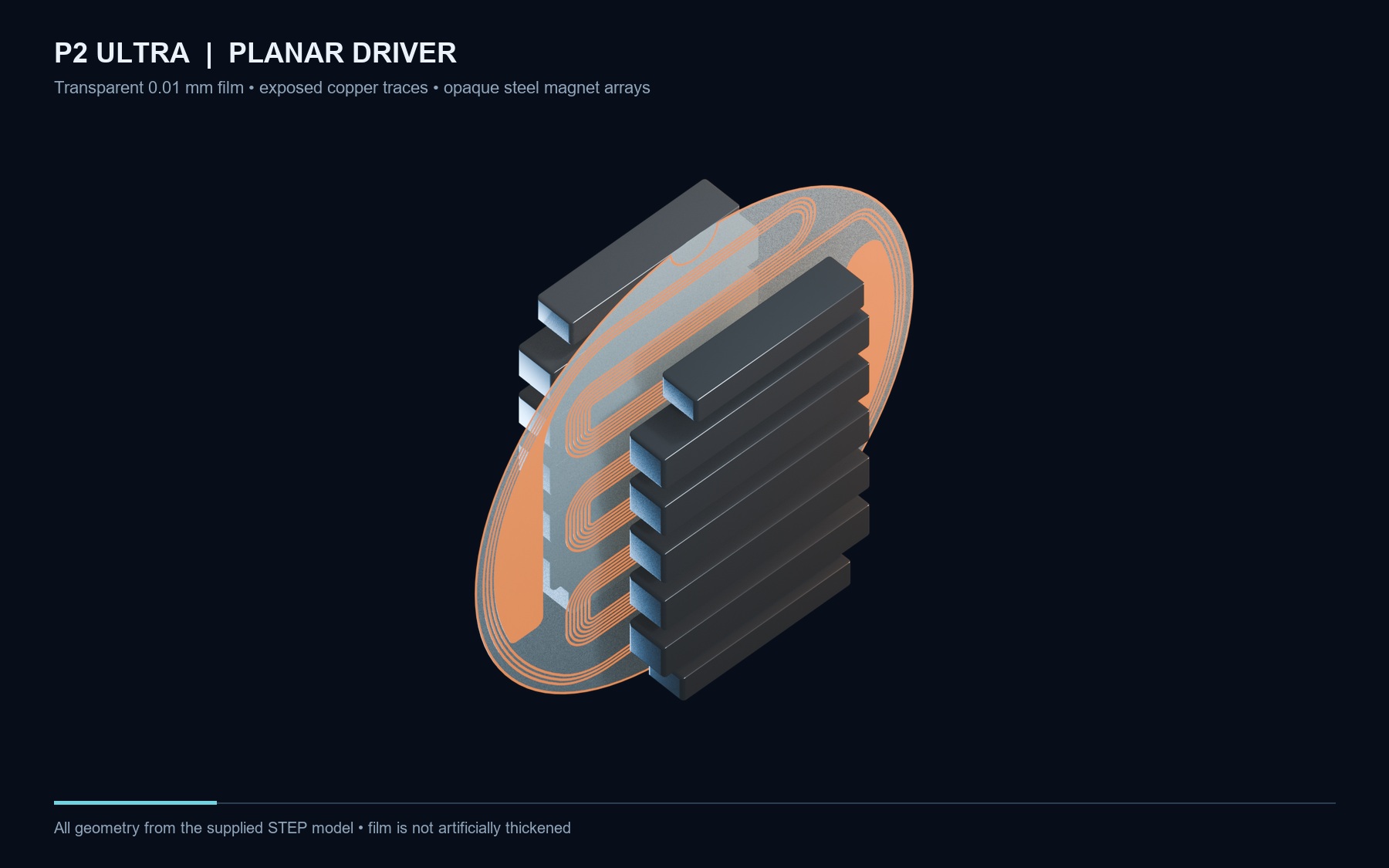
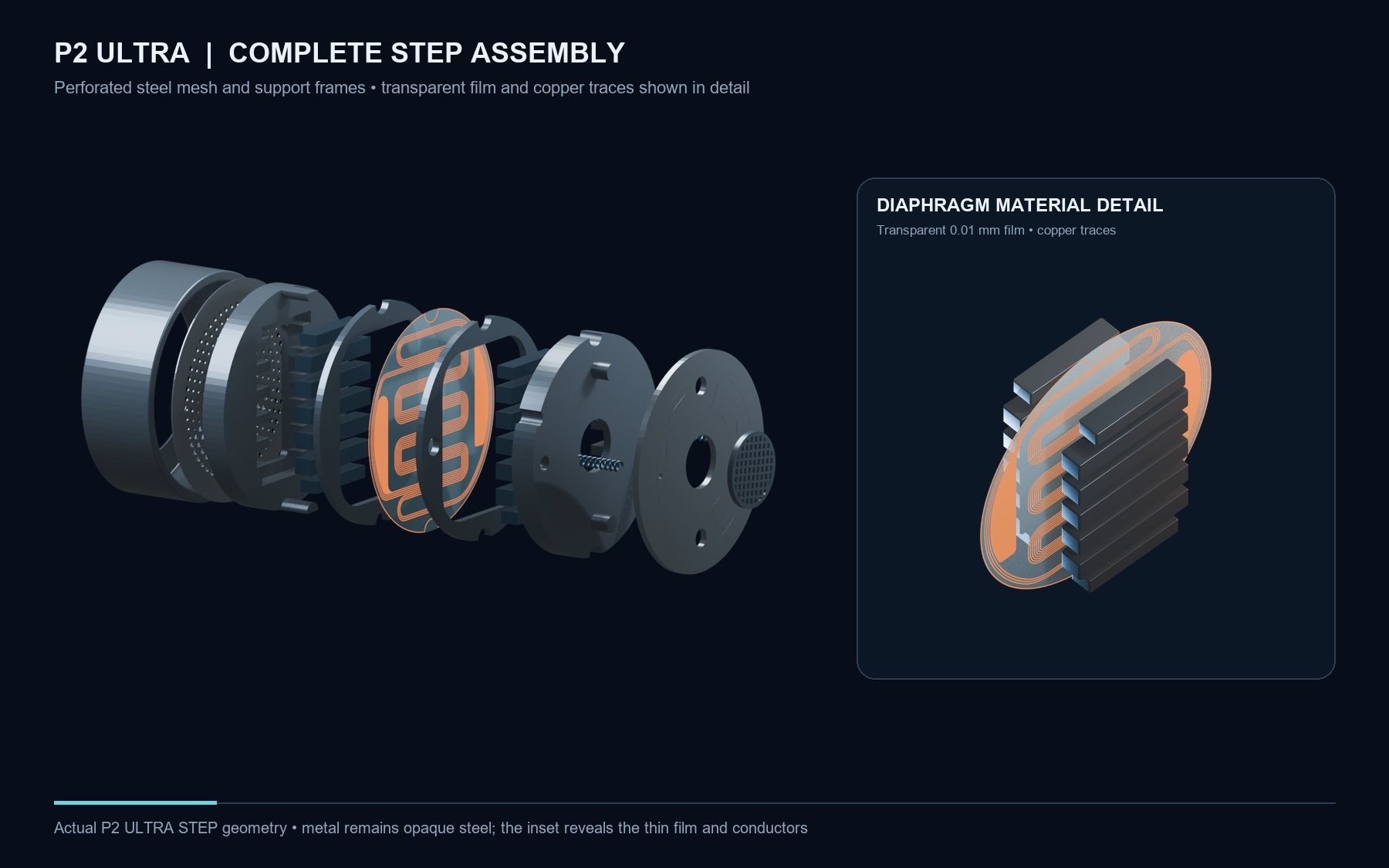
The P2 ULTRA STEP model shows a thin diaphragm carrying copper traces, positioned between magnet arrays. When audio current flows through the traces, the magnetic field exerts force on them. Because the conductor is spread across the film, the driving force acts over a broad area.
- Current flows through the copper traces. The music signal changes direction and strength over time.
- The traces interact with the magnetic field. The changing electromagnetic force makes the thin film move.
- The film moves air. Its motion creates pressure changes that travel through the earphone nozzle to the ear.
The film’s actual movement is extremely small. The STEP render separates the layers so their relationship is visible; the gaps do not represent the driver’s operating excursion.
How the TIN T7 dynamic driver works
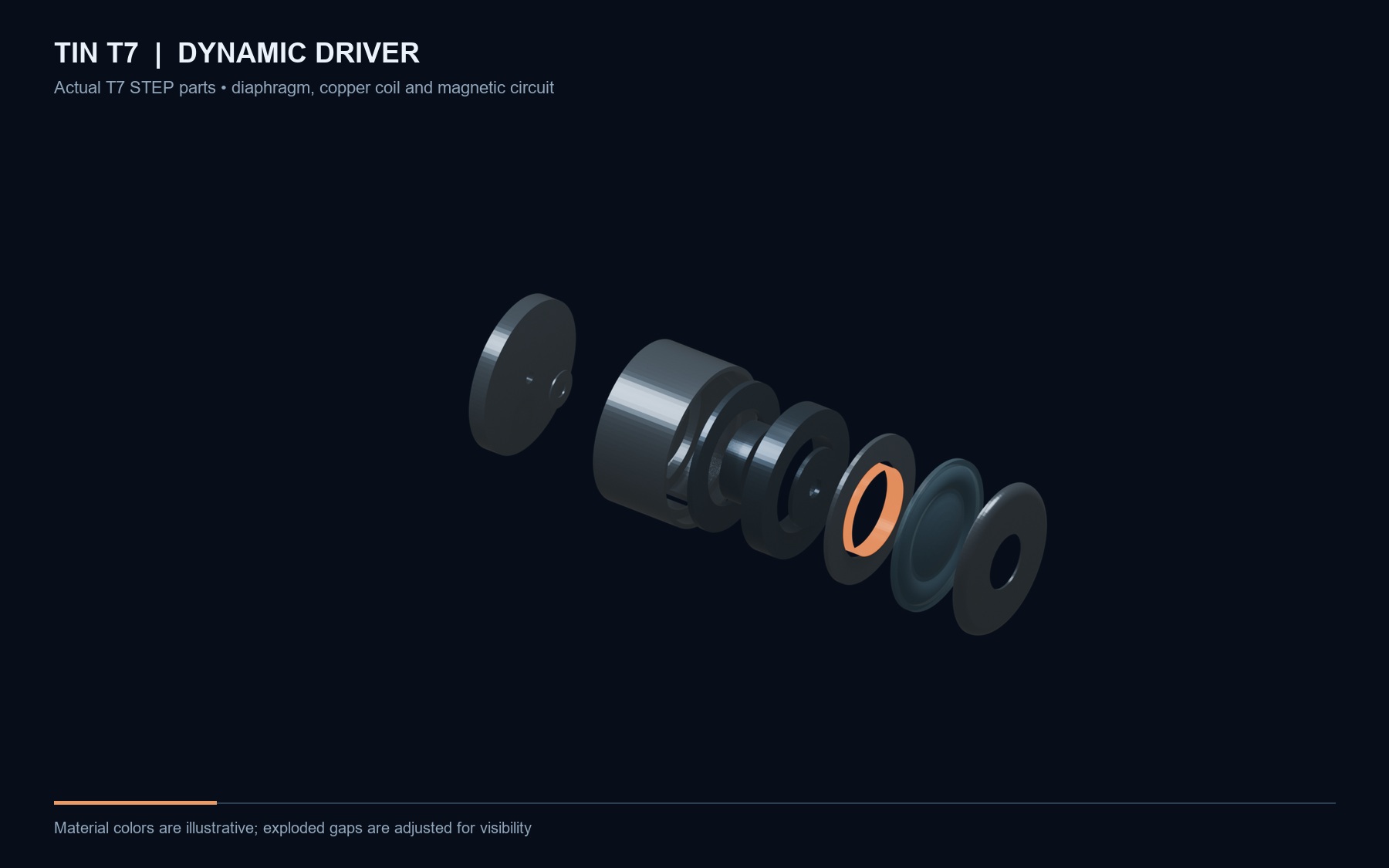
In a dynamic driver, a copper voice coil is attached to the diaphragm and sits in the magnetic gap. The magnetic circuit stays in place while audio current flows through the coil. The interaction between the coil’s current and the magnetic field produces a force; when the signal reverses, the force reverses too.
- The voice coil receives the audio signal.
- Electromagnetic force moves the coil. It travels back and forth along the driver’s axis.
- The attached diaphragm follows. It pushes and pulls nearby air, producing sound waves.
In real use, diaphragm travel is tiny. The exploded render helps show how the parts relate; it is not a scale drawing of the motion.
Planar vs dynamic IEM drivers at a glance
| Feature | P2 ULTRA planar example | TIN T7 dynamic example |
|---|---|---|
| Moving conductor | Traces carried on the diaphragm film | Voice coil attached to the diaphragm |
| Moving part | Thin diaphragm with distributed drive | Voice coil and attached diaphragm |
| Magnetic structure | Magnet arrays around the active film area in this model | Magnetic circuit with a gap around the coil in this model |
| What creates sound? | Diaphragm motion creates changing air pressure; both driver types do this. | |
Which driver sounds better?
Neither category guarantees better sound. “Planar” does not automatically mean more detail, a wider soundstage, or weak bass. “Dynamic” does not automatically mean warmer sound or stronger bass. The final result depends on driver design, frequency-response tuning, acoustic chamber, damping, distortion, ear-tip seal, and fit.
Power needs also depend on the specific IEM’s sensitivity and impedance. Check the model’s specifications and whether your source reaches a comfortable listening level cleanly. Do not assume every planar IEM needs a dedicated amplifier.
When comparing two earphones, match listening volume and use familiar tracks. Listen for vocal balance, bass control, treble comfort, fit, and fatigue over time. Choose the finished earphone that suits your music and ears, rather than paying for a driver label by itself.
Frequently asked questions
Does a planar IEM have a larger soundstage?
Not by driver category alone. Perceived space depends on tuning, channel matching, acoustic geometry, fit, and the recording. A planar driver cannot guarantee a wide soundstage.
Do planar IEMs need more power?
Some models may need more voltage or current than others, but the driver type alone is not enough to tell. Check sensitivity and impedance for the specific earphone.
Does a dynamic IEM always have better bass?
No. Bass quantity and quality depend on tuning, seal, acoustic loading, and distortion at the listening level. Both planar and dynamic IEMs can deliver strong, controlled bass when well implemented.
For more practical guidance, see whether a bigger IEM driver sounds better and when IEMs need a DAC. Interested in shaping a product around listening feedback? Explore Create Your IEM with XCHIFI.
Further reading: Audeze: planar magnetic technology and Campfire Audio: dynamic driver earphones.
2 thoughts on “Planar vs Dynamic IEM Drivers: How They Work”