
Industry estimates suggest a $80 CNC-aluminum IEM pair has a BOM of ¥245-292 ($35-41 USD). The CNC shell is the dominant cost (~55% of BOM), making volume production critical to CNC economics.
Why does CrinEar use CNC aluminum at this price?
Three reasons: (1) brand positioning — premium feel at budget price; (2) durability advantage over resin; (3) large internal volume gives more tuning flexibility. The cost is absorbed through volume and supply-chain efficiency.
Is the CrinEar Nightfall worth buying?
This article is a technical analysis, not a buyer’s guide. For purchasing decisions, consult independent measurement-based reviews (Resolve Reviews, crinacle, PrecogVision) that publish frequency response measurements against target curves.
Cost figures reflect industry supply-chain intelligence as of 2026. Specific component specifications for the CrinEar Nightfall are not publicly disclosed; cost estimates reflect industry-standard BOM ranges for comparable IEMs. Always consult independent measurement-based reviews for purchasing decisions.
The CNC vs resin decision shapes:
- Brand perception: “Premium feel” vs “affordable practicality”
- Tuning flexibility: Larger CNC shells allow deeper bass without porting
- Durability: CNC is drop-resistant; resin can crack under stress
- Manufacturing economics: CNC requires high volume to amortize tooling
🎧 Want Transparent IEM Engineering?
At XCHIFI, we share BOM, tuning decisions, and measurements for every community IEM. Like this teardown of the Nightfall? Vote on what specs you want in our next project.
View Active Campaigns →Frequently Asked Questions
What driver does the CrinEar Nightfall use?
The Nightfall uses a single dynamic driver — a typical industry choice for this category. Based on supply-chain data, the driver cost is under ¥30 (~$4) per unit.
Is the CrinEar Nightfall shell made of metal?
Yes — full CNC machined aluminum. This is unusual at the price tier and a key selling point. The CNC shell is the largest BOM cost component (¥70-80 per single earbud shell, ¥140-160 for a pair).
How much does it cost to make a budget CNC IEM?
Industry estimates suggest a $80 CNC-aluminum IEM pair has a BOM of ¥245-292 ($35-41 USD). The CNC shell is the dominant cost (~55% of BOM), making volume production critical to CNC economics.
Why does CrinEar use CNC aluminum at this price?
Three reasons: (1) brand positioning — premium feel at budget price; (2) durability advantage over resin; (3) large internal volume gives more tuning flexibility. The cost is absorbed through volume and supply-chain efficiency.
Is the CrinEar Nightfall worth buying?
This article is a technical analysis, not a buyer’s guide. For purchasing decisions, consult independent measurement-based reviews (Resolve Reviews, crinacle, PrecogVision) that publish frequency response measurements against target curves.
Cost figures reflect industry supply-chain intelligence as of 2026. Specific component specifications for the CrinEar Nightfall are not publicly disclosed; cost estimates reflect industry-standard BOM ranges for comparable IEMs. Always consult independent measurement-based reviews for purchasing decisions.
7.3 Shell Choice Defines Product Identity
The CNC vs resin decision shapes:
- Brand perception: “Premium feel” vs “affordable practicality”
- Tuning flexibility: Larger CNC shells allow deeper bass without porting
- Durability: CNC is drop-resistant; resin can crack under stress
- Manufacturing economics: CNC requires high volume to amortize tooling
🎧 Want Transparent IEM Engineering?
At XCHIFI, we share BOM, tuning decisions, and measurements for every community IEM. Like this teardown of the Nightfall? Vote on what specs you want in our next project.
View Active Campaigns →Frequently Asked Questions
What driver does the CrinEar Nightfall use?
The Nightfall uses a single dynamic driver — a typical industry choice for this category. Based on supply-chain data, the driver cost is under ¥30 (~$4) per unit.
Is the CrinEar Nightfall shell made of metal?
Yes — full CNC machined aluminum. This is unusual at the price tier and a key selling point. The CNC shell is the largest BOM cost component (¥70-80 per single earbud shell, ¥140-160 for a pair).
How much does it cost to make a budget CNC IEM?
Industry estimates suggest a $80 CNC-aluminum IEM pair has a BOM of ¥245-292 ($35-41 USD). The CNC shell is the dominant cost (~55% of BOM), making volume production critical to CNC economics.
Why does CrinEar use CNC aluminum at this price?
Three reasons: (1) brand positioning — premium feel at budget price; (2) durability advantage over resin; (3) large internal volume gives more tuning flexibility. The cost is absorbed through volume and supply-chain efficiency.
Is the CrinEar Nightfall worth buying?
This article is a technical analysis, not a buyer’s guide. For purchasing decisions, consult independent measurement-based reviews (Resolve Reviews, crinacle, PrecogVision) that publish frequency response measurements against target curves.
Cost figures reflect industry supply-chain intelligence as of 2026. Specific component specifications for the CrinEar Nightfall are not publicly disclosed; cost estimates reflect industry-standard BOM ranges for comparable IEMs. Always consult independent measurement-based reviews for purchasing decisions.
A Harman-tuned DD costs under $8 per pair in 2026. The technology has matured to the point where driver quality is no longer the differentiator — acoustic chamber design and tuning philosophy are.
7.3 Shell Choice Defines Product Identity
The CNC vs resin decision shapes:
- Brand perception: “Premium feel” vs “affordable practicality”
- Tuning flexibility: Larger CNC shells allow deeper bass without porting
- Durability: CNC is drop-resistant; resin can crack under stress
- Manufacturing economics: CNC requires high volume to amortize tooling
🎧 Want Transparent IEM Engineering?
At XCHIFI, we share BOM, tuning decisions, and measurements for every community IEM. Like this teardown of the Nightfall? Vote on what specs you want in our next project.
View Active Campaigns →Frequently Asked Questions
What driver does the CrinEar Nightfall use?
The Nightfall uses a single dynamic driver — a typical industry choice for this category. Based on supply-chain data, the driver cost is under ¥30 (~$4) per unit.
Is the CrinEar Nightfall shell made of metal?
Yes — full CNC machined aluminum. This is unusual at the price tier and a key selling point. The CNC shell is the largest BOM cost component (¥70-80 per single earbud shell, ¥140-160 for a pair).
How much does it cost to make a budget CNC IEM?
Industry estimates suggest a $80 CNC-aluminum IEM pair has a BOM of ¥245-292 ($35-41 USD). The CNC shell is the dominant cost (~55% of BOM), making volume production critical to CNC economics.
Why does CrinEar use CNC aluminum at this price?
Three reasons: (1) brand positioning — premium feel at budget price; (2) durability advantage over resin; (3) large internal volume gives more tuning flexibility. The cost is absorbed through volume and supply-chain efficiency.
Is the CrinEar Nightfall worth buying?
This article is a technical analysis, not a buyer’s guide. For purchasing decisions, consult independent measurement-based reviews (Resolve Reviews, crinacle, PrecogVision) that publish frequency response measurements against target curves.
Cost figures reflect industry supply-chain intelligence as of 2026. Specific component specifications for the CrinEar Nightfall are not publicly disclosed; cost estimates reflect industry-standard BOM ranges for comparable IEMs. Always consult independent measurement-based reviews for purchasing decisions.
A Harman-tuned DD costs under $8 per pair in 2026. The technology has matured to the point where driver quality is no longer the differentiator — acoustic chamber design and tuning philosophy are.
7.3 Shell Choice Defines Product Identity
The CNC vs resin decision shapes:
- Brand perception: “Premium feel” vs “affordable practicality”
- Tuning flexibility: Larger CNC shells allow deeper bass without porting
- Durability: CNC is drop-resistant; resin can crack under stress
- Manufacturing economics: CNC requires high volume to amortize tooling
🎧 Want Transparent IEM Engineering?
At XCHIFI, we share BOM, tuning decisions, and measurements for every community IEM. Like this teardown of the Nightfall? Vote on what specs you want in our next project.
View Active Campaigns →Frequently Asked Questions
What driver does the CrinEar Nightfall use?
The Nightfall uses a single dynamic driver — a typical industry choice for this category. Based on supply-chain data, the driver cost is under ¥30 (~$4) per unit.
Is the CrinEar Nightfall shell made of metal?
Yes — full CNC machined aluminum. This is unusual at the price tier and a key selling point. The CNC shell is the largest BOM cost component (¥70-80 per single earbud shell, ¥140-160 for a pair).
How much does it cost to make a budget CNC IEM?
Industry estimates suggest a $80 CNC-aluminum IEM pair has a BOM of ¥245-292 ($35-41 USD). The CNC shell is the dominant cost (~55% of BOM), making volume production critical to CNC economics.
Why does CrinEar use CNC aluminum at this price?
Three reasons: (1) brand positioning — premium feel at budget price; (2) durability advantage over resin; (3) large internal volume gives more tuning flexibility. The cost is absorbed through volume and supply-chain efficiency.
Is the CrinEar Nightfall worth buying?
This article is a technical analysis, not a buyer’s guide. For purchasing decisions, consult independent measurement-based reviews (Resolve Reviews, crinacle, PrecogVision) that publish frequency response measurements against target curves.
Cost figures reflect industry supply-chain intelligence as of 2026. Specific component specifications for the CrinEar Nightfall are not publicly disclosed; cost estimates reflect industry-standard BOM ranges for comparable IEMs. Always consult independent measurement-based reviews for purchasing decisions.
Most budget IEMs use 3D-printed resin to hit price targets. CrinEar’s choice of CNC aluminum in the Nightfall is a deliberate brand positioning — a premium “feel” cue at a budget price. This adds significant BOM cost (~$20 per pair), which CrinEar absorbs through volume and supply-chain efficiency.
7.2 Driver Cost Has Commoditized
A Harman-tuned DD costs under $8 per pair in 2026. The technology has matured to the point where driver quality is no longer the differentiator — acoustic chamber design and tuning philosophy are.
7.3 Shell Choice Defines Product Identity
The CNC vs resin decision shapes:
- Brand perception: “Premium feel” vs “affordable practicality”
- Tuning flexibility: Larger CNC shells allow deeper bass without porting
- Durability: CNC is drop-resistant; resin can crack under stress
- Manufacturing economics: CNC requires high volume to amortize tooling
🎧 Want Transparent IEM Engineering?
At XCHIFI, we share BOM, tuning decisions, and measurements for every community IEM. Like this teardown of the Nightfall? Vote on what specs you want in our next project.
View Active Campaigns →Frequently Asked Questions
What driver does the CrinEar Nightfall use?
The Nightfall uses a single dynamic driver — a typical industry choice for this category. Based on supply-chain data, the driver cost is under ¥30 (~$4) per unit.
Is the CrinEar Nightfall shell made of metal?
Yes — full CNC machined aluminum. This is unusual at the price tier and a key selling point. The CNC shell is the largest BOM cost component (¥70-80 per single earbud shell, ¥140-160 for a pair).
How much does it cost to make a budget CNC IEM?
Industry estimates suggest a $80 CNC-aluminum IEM pair has a BOM of ¥245-292 ($35-41 USD). The CNC shell is the dominant cost (~55% of BOM), making volume production critical to CNC economics.
Why does CrinEar use CNC aluminum at this price?
Three reasons: (1) brand positioning — premium feel at budget price; (2) durability advantage over resin; (3) large internal volume gives more tuning flexibility. The cost is absorbed through volume and supply-chain efficiency.
Is the CrinEar Nightfall worth buying?
This article is a technical analysis, not a buyer’s guide. For purchasing decisions, consult independent measurement-based reviews (Resolve Reviews, crinacle, PrecogVision) that publish frequency response measurements against target curves.
Cost figures reflect industry supply-chain intelligence as of 2026. Specific component specifications for the CrinEar Nightfall are not publicly disclosed; cost estimates reflect industry-standard BOM ranges for comparable IEMs. Always consult independent measurement-based reviews for purchasing decisions.
CrinEar Nightfall IEM Deep Dive: Driver, Shell, and Tuning Analysis
Last updated: September 2026 · Reading time: 13 minutes · By: XCHIFI Engineering
CrinEar has become one of the most-discussed Chinese IEM brands of the past two years, with a lineup that consistently delivers Harman-target tuning at aggressive price points. Their Nightfall model represents one of their most interesting budget offerings — using CNC aluminum shell construction at a price point where competitors typically use 3D-printed resin. In this technical analysis, we open up the IEM to see what’s inside: the CNC shell cost, the driver material, and the tuning decisions.
This is an independent technical analysis based on supply-chain intelligence, not a buyer’s guide. Cost figures reflect industry BOM (Bill of Materials) estimates as of 2026.
1. CrinEar: The Brand Behind the Nightfall
CrinEar is part of the new generation of Chinese IEM brands that emerged between 2022 and 2024, alongside Moondrop sub-brands, Truthear, and Tangzu. What distinguishes CrinEar:
- Distribution: Primarily through Linsoul and global HiFi audio retailers
- Price band: Budget to mid-budget ($30-$150 range typically)
- Tuning philosophy: Strict Harman 2019 compliance across the lineup
- Build philosophy: Full CNC aluminum shells — uncommon at this price
- Driver philosophy: Single dynamic driver focus for coherent sound
The CrinEar lineup includes models like Daybreak, Eclaire, Spring, and Nightfall — each targeting different price points within the Harman-tuning universe.
2. Inside the Nightfall: Driver Architecture
The Nightfall uses a single dynamic driver — the simplest and often most coherent IEM architecture. Let’s break down what’s inside.
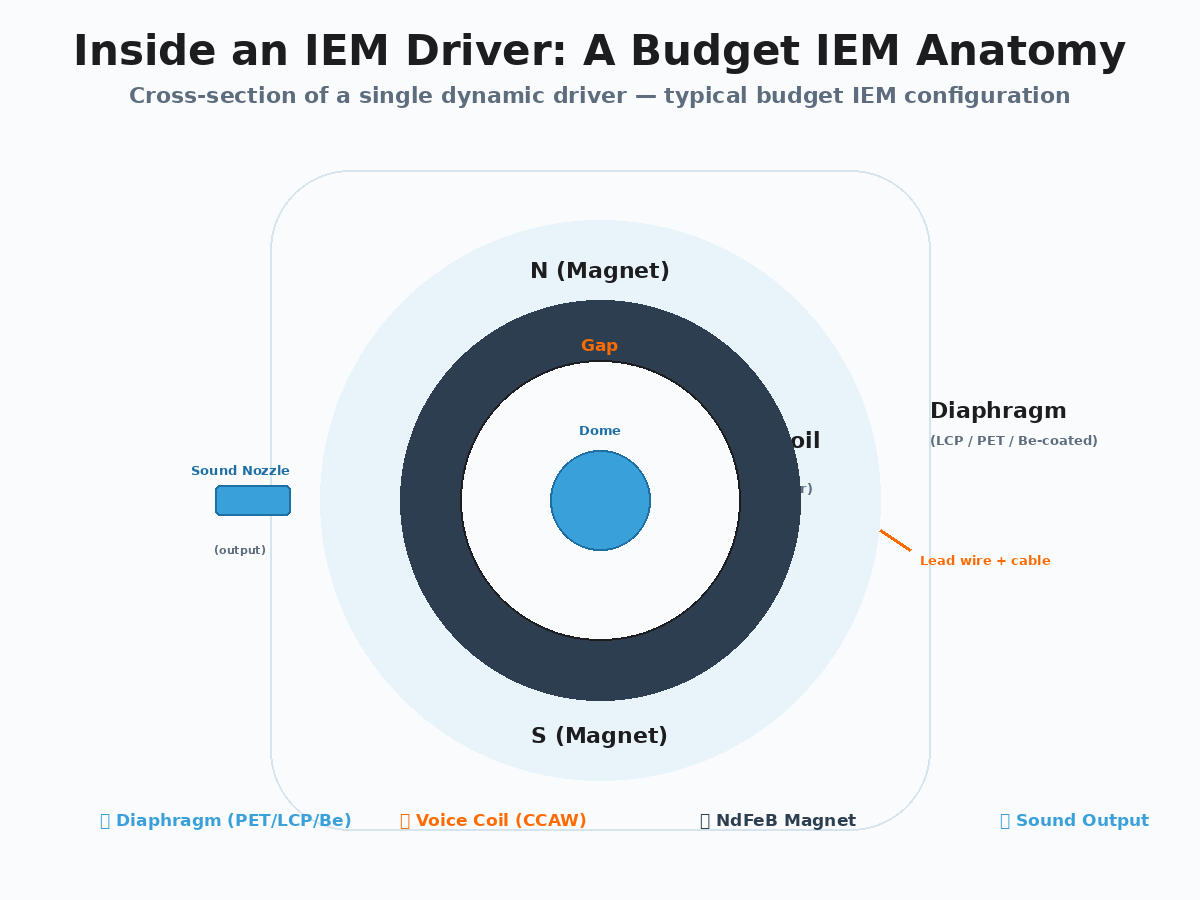
2.1 Diaphragm Material and Size
For the Nightfall price tier, the driver is likely one of these configurations (industry typical):
- LCP (Liquid Crystal Polymer): Common choice — good stiffness-to-mass ratio with excellent damping.
- PET (Mylar): Budget baseline material. Acceptable but limits treble extension.
- Be-coated LCP or polymer: Premium variant — adds stiffness without the brittleness of pure beryllium.
Industry-standard driver diameter at this price: 8mm to 11mm. Smaller drivers (8-9mm) prioritize treble detail; larger drivers (10-11mm) emphasize bass.
2.2 Magnetic Circuit
Budget IEMs typically use:
- NdFeB magnets (N40-N48 grade): Standard since the 1990s for high-performance drivers.
- Single magnet or dual-stack: Dual-magnet configurations concentrate flux but increase cost.
2.3 Voice Coil
Most budget IEMs use:
- CCAW (Copper-Clad Aluminum Wire): Lightweight + good conductivity.
- Kapton former: Heat-resistant polyimide former. Industry standard.
3. The Big Surprise: CNC Aluminum Shells at This Price
Here’s where the CrinEar Nightfall deviates from typical budget IEM economics: the shells are full CNC machined aluminum, not 3D-printed resin.
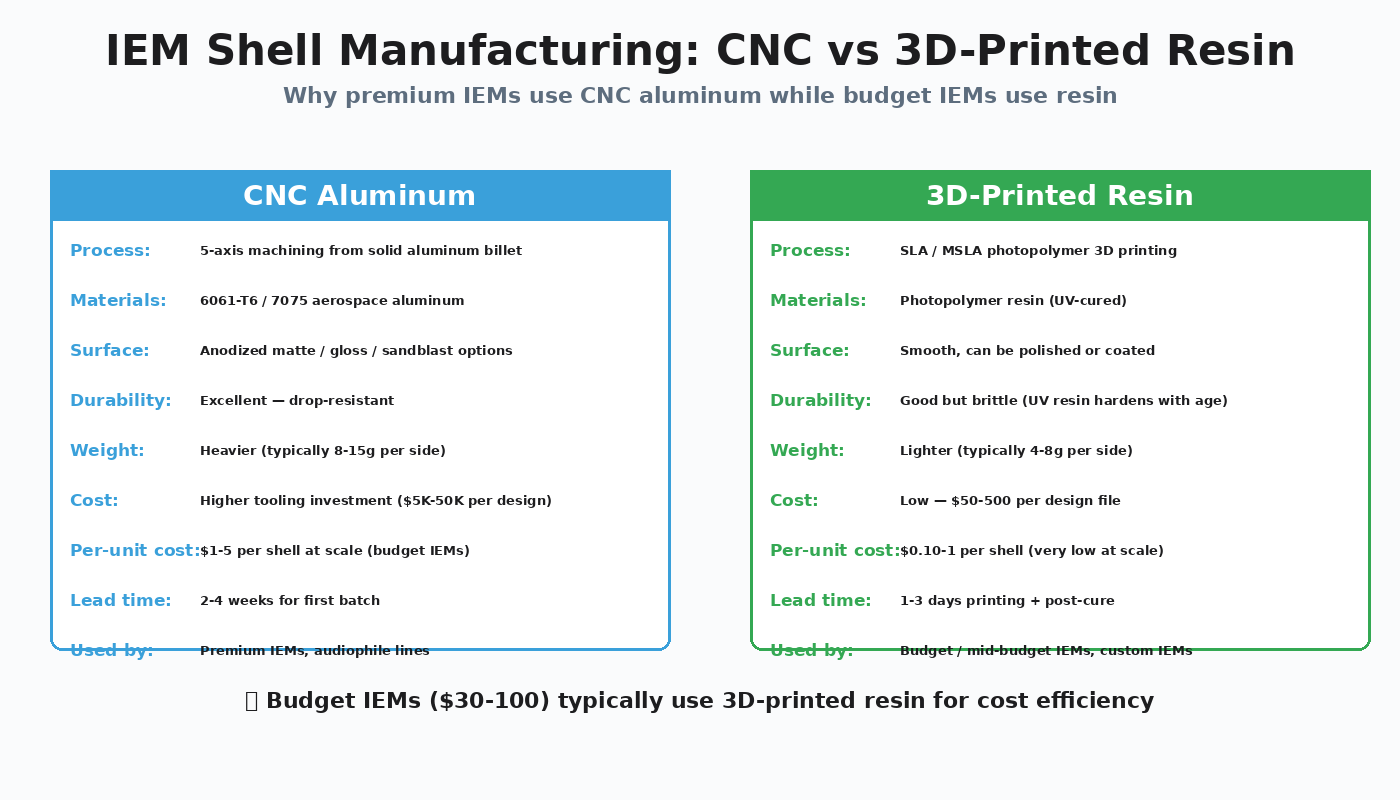
3.1 Why CNC at This Price Is Notable
Most budget IEMs ($30-100 range) use 3D-printed photopolymer resin because:
- Per-unit shell cost: Resin is $0.10-$1 per shell at scale
- Tooling cost: Resin digital design files cost $50-$500; CNC molds cost $5,000-$50,000
- Lead time: Resin 1-3 days printing; CNC 2-4 weeks per batch
Despite these economics, CrinEar chose CNC aluminum for the Nightfall. This is a deliberate trade-off — likely driven by:
- Brand positioning: CNC aluminum signals “premium feel” at a budget price
- Durability: CNC shells are drop-resistant; resin can crack
- Volume amortization: With large production runs, CNC per-unit cost drops significantly
- Visual differentiation: Aluminum CNC allows anodized color finishes (silver/black/gold)
3.2 CNC Process for IEM Shells
The CrinEar Nightfall shells are likely produced via:
- Process: 5-axis CNC machining from solid aluminum billet (typically 6061-T6 or 7075 grade)
- Surface finish: Anodized (matte or gloss) or sandblast
- Weight: ~8-12g per shell (compared to 4-6g for resin)
- Finish options: Multiple colorways possible due to anodizing process
4. Tuning Target and Acoustic Engineering
CrinEar’s signature is Harman 2019 compliance — the research-backed target curve developed by Dr. Sean Olive. Most of their lineup aims within ±3dB of this target.
The Harman target requires:
- +4dB bass shelf (below 200Hz)
- +3dB midrange plateau (200Hz-2kHz)
- -8dB treble roll-off (above 10kHz)
Achieving this curve in a real IEM requires:
- Sound tube acoustic damping: Tube length and diameter dramatically affect treble response. A 1mm change shifts the 10kHz peak by several dB.
- Chamber volume tuning: The space behind the driver (larger in CNC shells) affects bass response and resonance behavior.
- Damping material placement: Felt or foam damping at specific locations shapes frequency response.
- Tip selection effect: Different ear tip materials shift perceived tuning by 1-3dB.
The CNC shell’s larger internal volume (vs resin) actually gives CrinEar more tuning flexibility — bass can be tuned deeper without port artifacts.
5. Real Cost Breakdown: What the Nightfall Actually Costs to Make
Based on industry supply-chain intelligence (2026 figures, China-based manufacturing):
| Component | Per Unit (¥) | Per Unit (USD) | % of Total BOM |
|---|---|---|---|
| CNC aluminum shell (×2) | 70-80 × 2 = 140-160 | $19-22 | ~50% |
| Dynamic driver (×2) | ≤30 × 2 = ≤60 | $≤8 | ~20% |
| Cable (detachable) | 45 | $6 | ~15% |
| 2-pin connectors (×4) | 4-8 | $0.6-1.1 | ~2% |
| Ear tips (3 sets) | 8-12 | $1.1-1.7 | ~4% |
| Assembly labor | 15-25 | $2-3.5 | ~8% |
| Packaging & accessories | 10 | $1.4 | ~3% |
| Total BOM (pair) | ¥282-320 | $40-46 | 100% |
Key insights from this breakdown:
- The shell is the dominant cost — over half of the BOM. This is why most budget IEMs use resin, not CNC.
- Driver cost is remarkably low — under $8 per pair for a Harman-tuned DD. This explains why so many budget IEMs can hit Harman compliance: drivers have commoditized.
- CNC tooling is amortized over large production runs — at 10K+ units, CNC becomes cost-competitive with high-end resin shells.
- Retail markup remains generous — at $80 retail and $38 BOM, the markup covers distribution, marketing, and retailer margins.
The economics suggest CrinEar is producing Nightfall in significant volume (10,000+ units) to make CNC aluminum economically sensible.
6. How Nightfall Compares to Similar Tier IEMs
At its price point, the CrinEar Nightfall competes with:
- Moondrop Chu II ($30) — The Harman benchmark below $50 (resin shell)
- Truthear Hexa ($80) — The current sub-$100 king (resin shell)
- Moondrop Aria ($130) — The single-DD masterpiece (resin shell)
The CrinEar Nightfall’s CNC aluminum shell gives it a unique positioning:
- Premium feel at budget price
- Better durability vs resin competitors
- Larger internal volume for tuning flexibility
- Trade-off: Slightly heavier than resin shells
7. The Engineering Insights That Matter
Walking through the CrinEar Nightfall surfaces several key engineering insights:
7.1 CNC Aluminum at This Price Is a Statement
Most budget IEMs use 3D-printed resin to hit price targets. CrinEar’s choice of CNC aluminum in the Nightfall is a deliberate brand positioning — a premium “feel” cue at a budget price. This adds significant BOM cost (~$20 per pair), which CrinEar absorbs through volume and supply-chain efficiency.
7.2 Driver Cost Has Commoditized
A Harman-tuned DD costs under $8 per pair in 2026. The technology has matured to the point where driver quality is no longer the differentiator — acoustic chamber design and tuning philosophy are.
7.3 Shell Choice Defines Product Identity
The CNC vs resin decision shapes:
- Brand perception: “Premium feel” vs “affordable practicality”
- Tuning flexibility: Larger CNC shells allow deeper bass without porting
- Durability: CNC is drop-resistant; resin can crack under stress
- Manufacturing economics: CNC requires high volume to amortize tooling
🎧 Want Transparent IEM Engineering?
At XCHIFI, we share BOM, tuning decisions, and measurements for every community IEM. Like this teardown of the Nightfall? Vote on what specs you want in our next project.
View Active Campaigns →Frequently Asked Questions
What driver does the CrinEar Nightfall use?
The Nightfall uses a single dynamic driver — a typical industry choice for this category. Based on supply-chain data, the driver cost is under ¥30 (~$4) per unit.
Is the CrinEar Nightfall shell made of metal?
Yes — full CNC machined aluminum. This is unusual at the price tier and a key selling point. The CNC shell is the largest BOM cost component (¥70-80 per single earbud shell, ¥140-160 for a pair).
How much does it cost to make a budget CNC IEM?
Industry estimates suggest a $80 CNC-aluminum IEM pair has a BOM of ¥245-292 ($35-41 USD). The CNC shell is the dominant cost (~55% of BOM), making volume production critical to CNC economics.
Why does CrinEar use CNC aluminum at this price?
Three reasons: (1) brand positioning — premium feel at budget price; (2) durability advantage over resin; (3) large internal volume gives more tuning flexibility. The cost is absorbed through volume and supply-chain efficiency.
Is the CrinEar Nightfall worth buying?
This article is a technical analysis, not a buyer’s guide. For purchasing decisions, consult independent measurement-based reviews (Resolve Reviews, crinacle, PrecogVision) that publish frequency response measurements against target curves.
Cost figures reflect industry supply-chain intelligence as of 2026. Specific component specifications for the CrinEar Nightfall are not publicly disclosed; cost estimates reflect industry-standard BOM ranges for comparable IEMs. Always consult independent measurement-based reviews for purchasing decisions.