
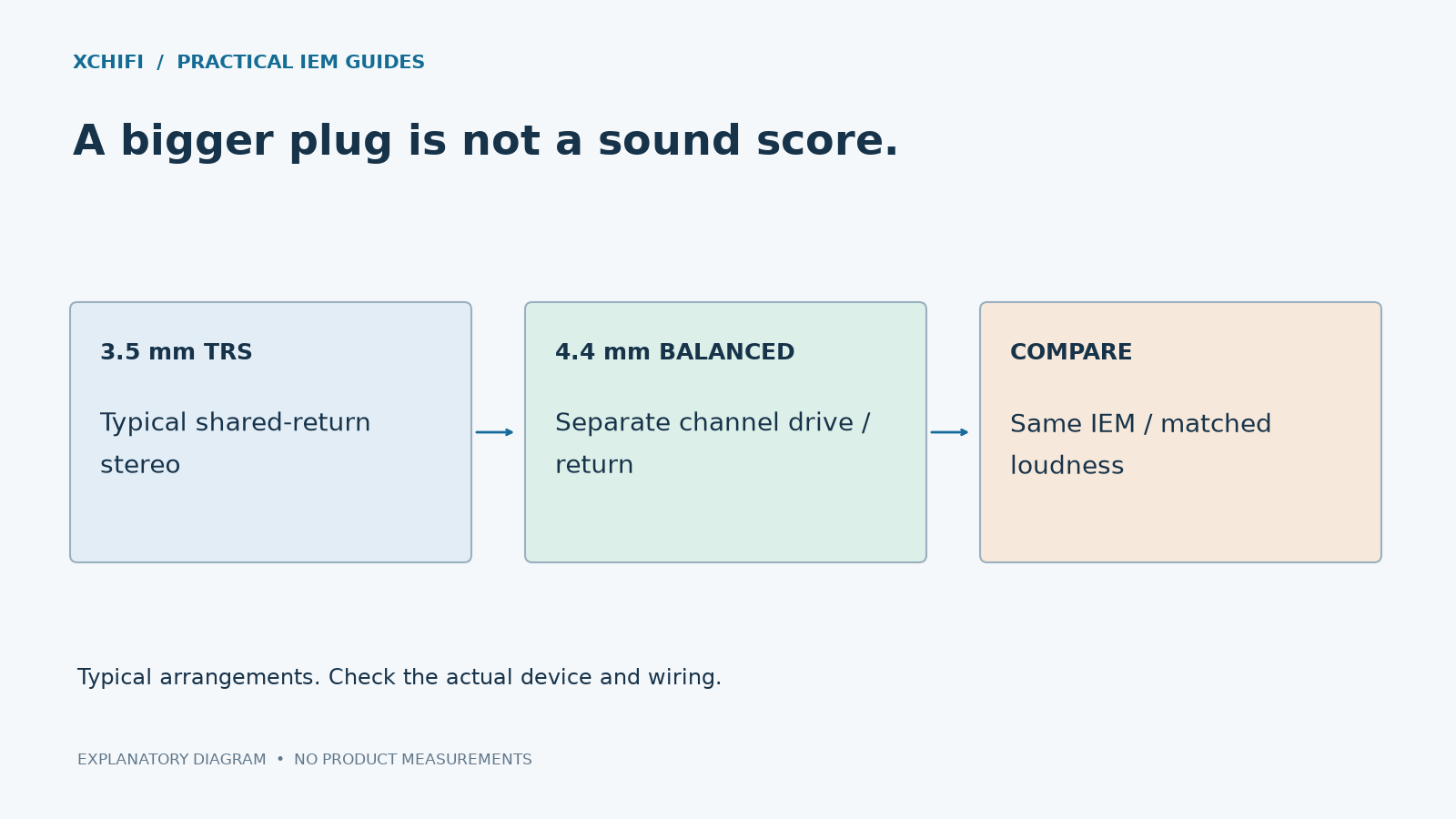
You do not need a 4.4 mm connection simply because an IEM is expensive. If your 3.5 mm output is clean, quiet and has enough headroom, changing plugs does not guarantee an audible improvement.
What actually changes?
A typical 3.5 mm TRS headphone output shares a return between channels. A typical balanced headphone output drives each channel across two amplifier outputs. The electronics—not the plug diameter—determine noise, distortion and available output.
Some devices provide more voltage or power from their balanced output. That can help a demanding load, but extra available power is not automatically useful for a sensitive IEM. Check the specifications of both outputs under the relevant load.
When is it worth considering?
- Your current output cannot reach the required clean level with adequate headroom.
- The device’s balanced output has a documented advantage relevant to your IEM.
- You already have a correctly wired, compatible balanced cable and want to compare.
Match loudness before judging. Using the same volume number can make the higher-gain output louder, which is not a fair sound-quality comparison.
Do not solve compatibility with a random adapter
A passive adapter that ties active balanced output terminals together or to a shared return can damage an amplifier. Do not connect a single-ended headphone cable to a balanced amplifier output unless the manufacturer explicitly approves the arrangement.
A correctly wired balanced-headphone-to-single-ended-source adapter is a different direction of conversion. Verify the exact wiring and device instructions; “fits the socket” is not enough.
Technical references: Why output-conversion wiring matters