
A kick drum should land with weight. A deep synth note should hold its shape. Then the singer comes in—and the voice should still be clear.
That is the brief for this proposed TINHIFI IEM. TINHIFI’s starting point is balanced tuning; this project would deliberately give bass a larger role. We want a bass-focused earphone for listeners who enjoy impact, without making every recording sound thick.
The first decision is not how many decibels to add. It is what sort of driver can deliver the required output cleanly, inside a housing people can comfortably wear.
Start with one dynamic driver
A nominal 10 mm dynamic driver is a sensible starting platform for the first prototype. That is a packaging choice, not a claim that 10 mm is the best bass size. A larger effective radiating area can provide more volume displacement for the same stroke, but published driver diameter does not necessarily equal effective diaphragm diameter.
The useful relationship is simple: volume displacement = effective diaphragm area × excursion. Area alone is not enough. The suspension and motor must allow the diaphragm to move through the required stroke without excessive distortion or mechanical contact. The seal and acoustic load then determine how that motion becomes pressure at the ear.
We would begin with one driver so the first prototype has fewer acoustic variables to manage. A second driver can be considered if the output requirement demands it; adding one is not a shortcut to good bass.
A stiff dome with a compliant surround
For the initial diaphragm, the candidate is an LCP-based central dome with a compliant polymer surround. PU or TPU are possible surround materials, subject to supplier process and bonding trials. This is a proposed composite assembly, not a selected production part.
The central area needs useful stiffness at low moving mass. The surround needs controlled compliance and damping so the assembly can move and return predictably. Making the whole diaphragm rigid is not the goal; making the suspension excessively soft can also introduce problems.
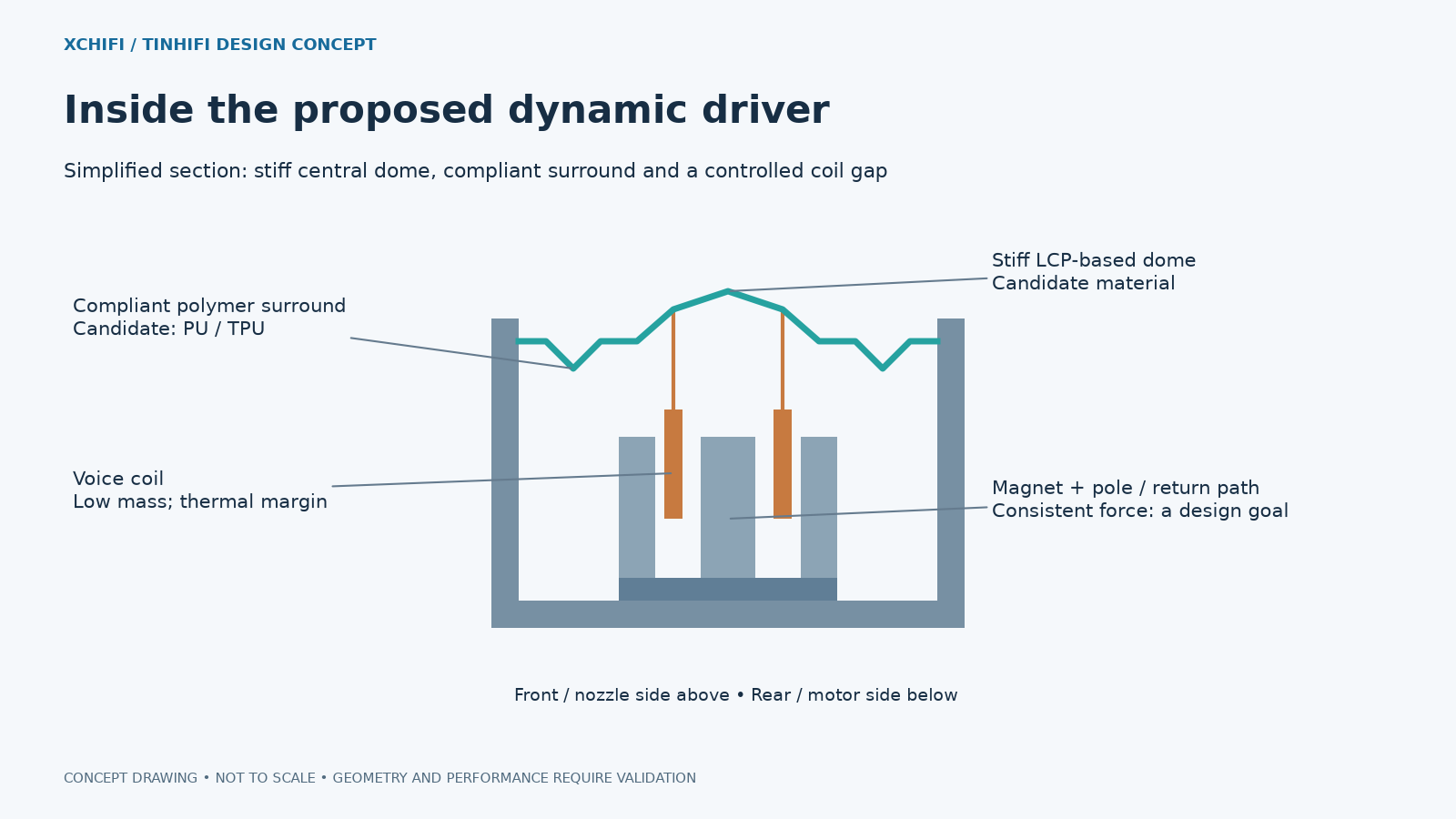
LCP is a starting candidate, not a promised sound signature. Film thickness, forming, coating, adhesive and surround geometry all change the result. A well-made PET-based assembly could outperform a poorly executed premium-material design. The material name does not decide which sample works.
The motor must stay controlled through the stroke
For bass, a strong magnet is useful only as part of a suitable motor. The voice coil should experience reasonably consistent driving force over its intended travel. The suspension should also behave consistently as it moves in both directions.
That puts the coil height, gap geometry, centering and clearance on the design list. We also need electrical and thermal margins: a coil that warms substantially changes resistance, while excessive input can push the assembly outside its useful operating range.
Coil wire, winding count and impedance should be chosen together after checking the available phone dongles and target output. Publishing an impedance number now would make the proposal look more finished than it is.
What do we mean by a dual-cavity design?
Here, “dual cavity” means a controlled front acoustic volume and rear acoustic volume around the driver. It does not mean two drivers, and it does not mean an extra cavity automatically increases bass.
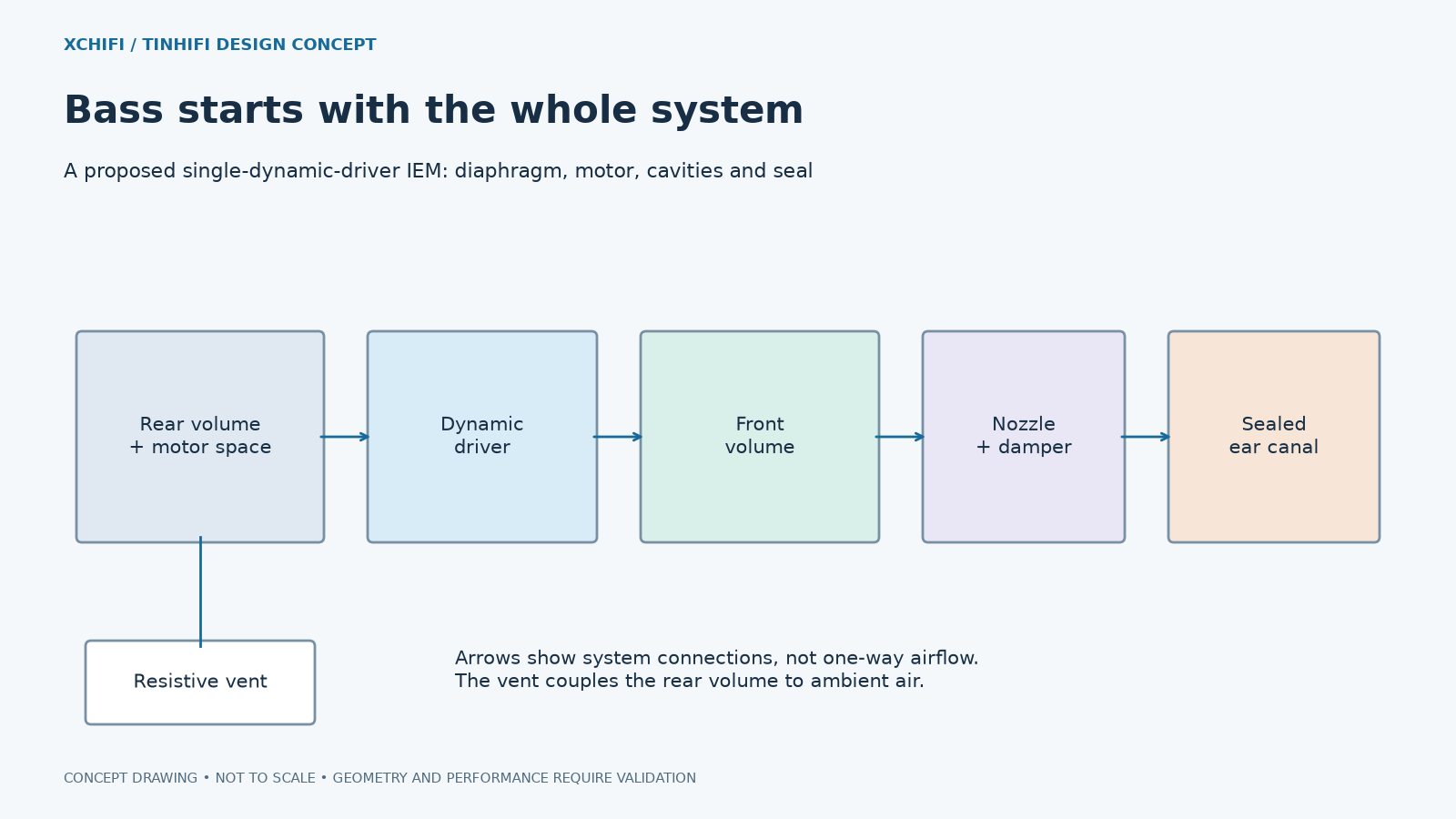
The front volume couples the diaphragm to the nozzle and ear canal. Its shape, nozzle dimensions and damping influence resonances and the midrange/treble response. It cannot be designed independently of fit.
The rear volume provides an acoustic load on the moving assembly. In a simplified sealed cavity, a larger volume has greater acoustic compliance; that does not mean the finished IEM will always produce more bass. Once vents, damping and the driver’s own back structure are involved, the complete network matters.
For the prototype, an accessible rear vent with replaceable resistive inserts would allow controlled changes. Vent resistance affects loading and pressure equalization. “Smaller hole means better bass” is not a reliable design rule. Fully blocking a vent can also create unwanted pressure effects and change driver behavior.
Weight down low, room for the voice
The proposed direction is extra sub-bass weight and enough mid-bass for a convincing kick, followed by a controlled return toward the lower midrange. Sub-bass is roughly 20–60 Hz; mid-bass roughly 60–200 Hz. These are descriptive ranges, not crossover settings.
We should not draw a supposedly ideal measured curve before a prototype exists. The bass shelf has to be set against the rest of the response, the ear simulator used and listening results. A broad boost extending too far into the lower mids can make the earphone sound thick even when its distortion is low.
Seal is part of that tuning. An IEM that delivers strong bass only when held in place by hand has failed the brief. Tip fit, nozzle position and comfort need to work together.
What would count as a successful design?
Not simply a tall bass shelf on a graph. The earphone should retain its intended response across sensible operating levels, avoid obvious distortion and output compression, and keep left and right channels consistent. Repeated fits should not turn its bass into a lottery.
Music gives the final brief practical meaning: sustained electronic bass should remain distinct from a kick; a bass guitar should still have identifiable notes; vocals should not disappear when the rhythm section enters. Those are listening goals, not reported results.
The open question for listeners is what kind of weight they want most: deep rumble, a firm kick, or a warmer all-round presentation. Those preferences lead to different tuning choices. This proposal starts that discussion before the hardware is fixed.
Related reading: Does a bigger IEM driver sound better? · Same FR, same sound?