
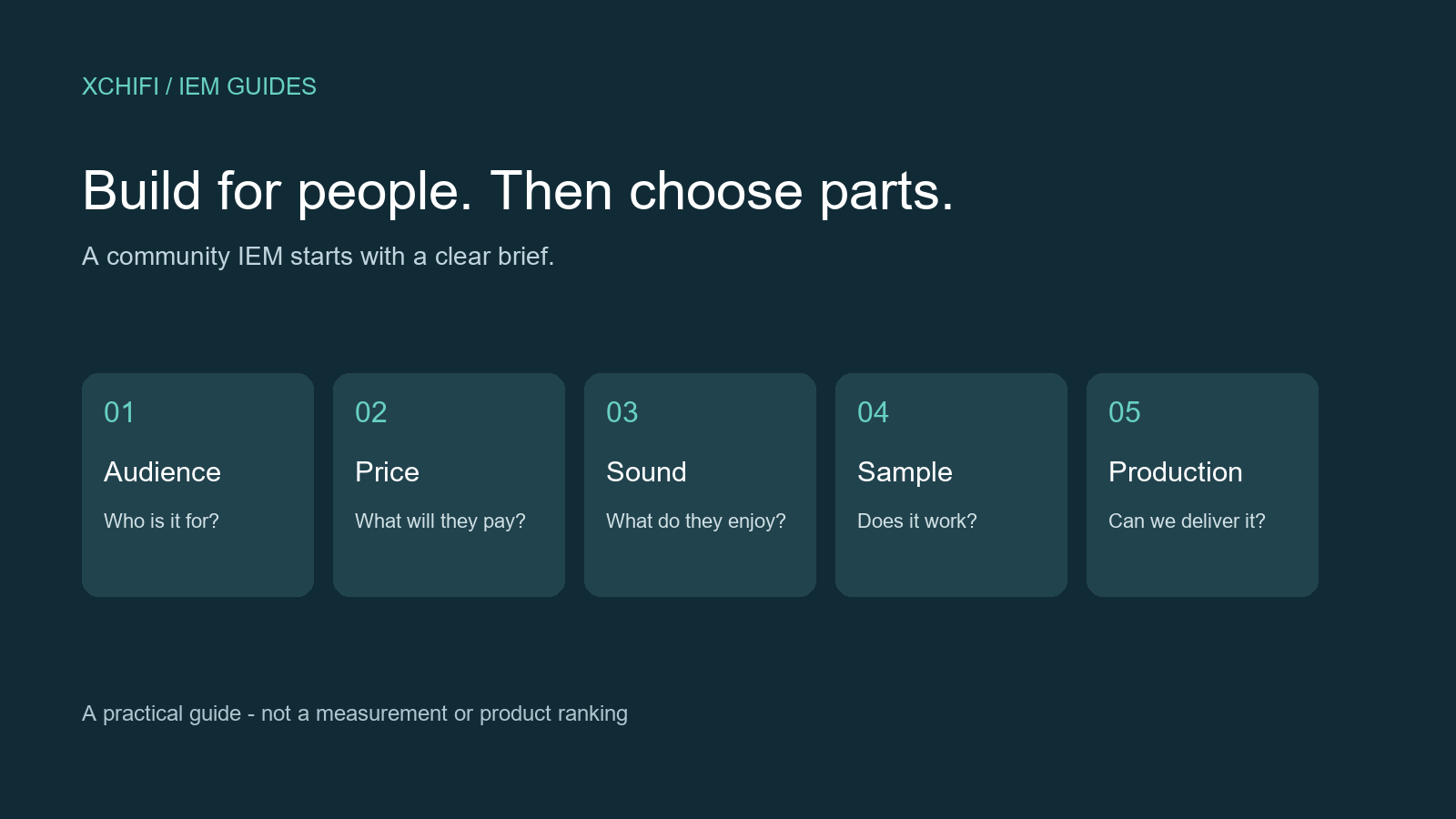
Before choosing a driver, answer three questions: who is this earphone for, what will they pay, and what sound do they want?
1. Find a real need
Talk to the people you want to serve. What do they use now? What bothers them: weak bass, a bulky shell, a poor microphone or the price? Read reviews for repeated complaints, then ask users directly. Likes on a post are not confirmed orders.
2. Set a target selling price
Choose the price the customer should pay before building a wish list of expensive parts. Work backwards: allow for development, parts, assembly, testing, packaging, delivery and after-sales support. Agree on what that price includes.
3. Describe the sound in plain words
“Strong bass without burying voices” is a clearer starting point than “flagship sound.” Bring familiar songs and reference earphones. Decide which trade-offs matter to the group, then translate that brief into acoustic targets.
4. Build a sample that fits the brief
Choose the driver and shell together. Check comfort, tuning, distortion and left-right consistency. Let intended users try the sample at comparable listening levels. Fix the problems before paying for production tooling.
5. Price the actual production plan
Get a written quote for the agreed design and quantity. Separate one-time development and tooling charges from the cost per pair. More orders can spread fixed costs, but also mean more money committed to stock.
For XCHIFI co-creation, start with the people and the idea. A working sample and a clear budget should come before a crowdfunding promise.
Explore IEM co-creation · Why driver size is only one design choice
Manufacturing background: Protolabs on tooling and production costs. No supplier quote or guaranteed campaign price is implied.