
SOURCE 02 · HEARING · 02 / 17
Human Hearing & Psychoacoustics
How people hear IEMs: hearing range, equal loudness, masking, critical bands, pitch and timbre, plus the two-ear cues that create a stereo image.
2.1 Hearing range: what can a listener actually hear?
A healthy young listener is often described as hearing from about 20 Hz to 20 kHz, but this is a useful boundary rather than a product target. High-frequency sensitivity commonly falls with age and noise exposure, and low-frequency audibility depends strongly on level and background noise. The practical range also extends from the threshold of hearing near 0 dB SPL to discomfort and potential injury at very high levels. For IEM tuning, a claimed frequency extension has value only when the output is audible, controlled and safe at the intended listening level.
2.2 Equal-loudness contours: volume is not linear
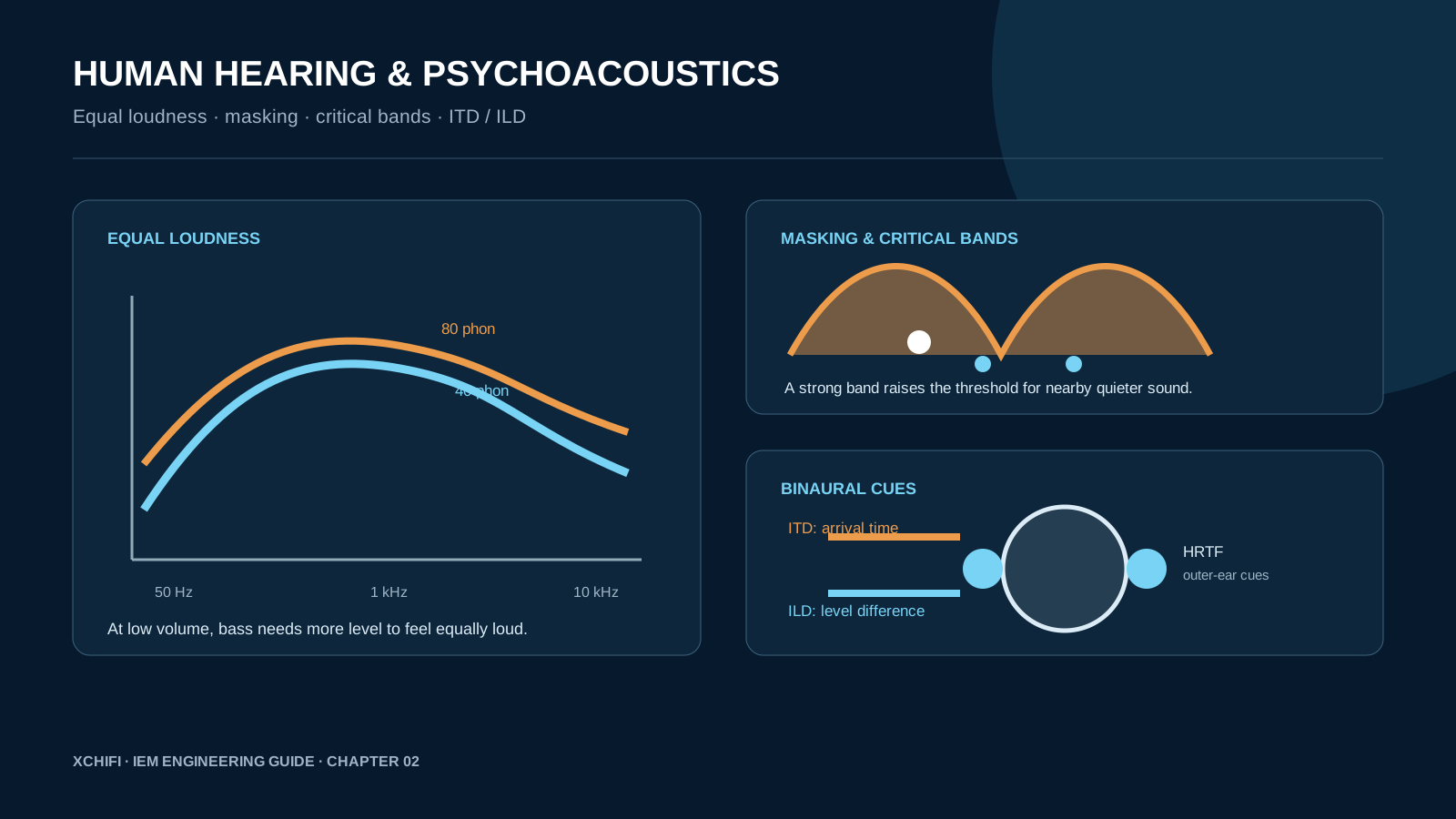
The ear is most sensitive through the midrange. At a modest listening level, 50 Hz needs substantially more sound pressure than 1 kHz to feel equally loud; very high frequencies also need extra energy. This is the meaning of an equal-loudness contour. At low volume, users often perceive less bass and treble; at higher volume, the same IEM can feel fuller and brighter. Evaluate a tuning at more than one level - quiet, normal and louder environmental use - before deciding that its balance is correct.
2.3 Masking: when one sound hides another
A strong sound raises the threshold for weaker sound nearby. Frequency masking occurs when a loud tone or musical band hides quieter information close to it. Temporal masking occurs just before and especially after a strong event; the after-effect can persist far longer than the brief pre-masking window. This matters in IEM tuning: a broad boost can cover vocal texture or cymbal detail even when a response curve looks detailed. It also explains why perceptual codecs can discard some masked information with little audible loss.
2.4 Critical bands: the ear frequency resolution
The auditory system does not divide sound into equal-width frequency bins. Its effective bandwidth is narrow in the low frequencies and wider in the high frequencies. The Bark scale is a practical description of these critical bands, with roughly twenty-four bands across the audible range. Masking is strongest within a band, which is why a narrow resonance can be more troublesome when it sits close to important musical information. Critical-band thinking also helps when choosing crossovers, dampers and EQ bandwidths.
2.5 Pitch and timbre: more than a frequency number
Pitch is related mainly to the fundamental repetition rate: A4 is conventionally 440 Hz. Timbre is the pattern around that fundamental - the harmonics, resonances and transient attack that let a violin, piano and voice remain recognisable at the same note. Playback level can slightly affect perceived pitch, while an IEM resonance in the presence region can alter the harmonic balance that makes an instrument sound natural. A response target therefore cannot be judged only by how smooth it looks; it must preserve recognisable musical character.
2.6 Binaural hearing: why two ears create a soundstage
The brain locates sound by comparing tiny differences between ears. Interaural time difference, ITD, tells it which ear received a sound first; interaural level difference, ILD, becomes especially useful at high frequencies because the head shadows one ear. The outer ear also filters incoming sound, creating HRTF cues that help distinguish front, back, above and below. IEMs do not reproduce a real room, but accurate channel matching, stable seal and careful spatial processing protect the stereo image. Generic virtual-surround filters should be optional because ear shape varies between listeners.